



Microsoft Previews Shader Model 6.10 with New DirectX GPU Features


Well, with the upcoming release of DirectX Shader Model 6.10 alongside the new Agility SDK 1.720-preview, that all changes. The big feature this time around is the new "linalg::Matrix" API, which provides a method for developers to make use of the matrix math hardware present inside nearly every GPU nowadays regardless of which GPU vendor the user is running, directly inside standard HLSL shader code. Game developers can make use of any kind of neural rendering or really do whatever they want with a whole section of GPU hardware that was mostly off-limits until now.
Beyond that, Shader Model 6.10 also introduces Variable Group Shared Memory. You see, matrix operations let you manipulate a whole bunch of data at once, but you can't do that unless you can fit all that data into your working memory. Well, back in 2009, Microsoft set a limit of 32KB for the size of "group shared memory," which is the memory that a specific thread group within the GPU can work on. 32KB is pathetically small by modern standards, and so that limit can now be raised, which just so happens to be critical for the linear algebra API above.
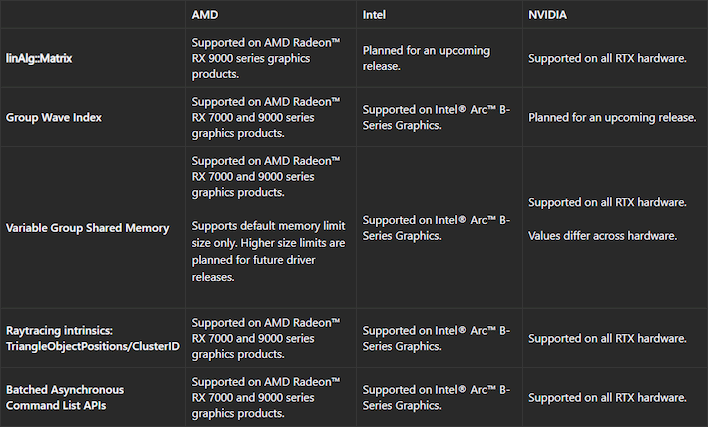
Microsoft is also giving developers better tools to manage how the GPU actually schedules and executes its work. Batched Asynchronous Command Lists remove the old "implicit serialization" rules, allowing the GPU driver to overlap independent tasks within a single batch call. That translates to less time waiting around and better overall performance. It also introduces modern, highly requested commands like ClearTextureSubresources, which finally allows for clearing block-compressed formats directly.
Also, new intrinsics (GetGroupWaveIndex() and GetGroupWaveCount()) give shaders direct, safe knowledge of their wave-level structure. Developers previously had to rely on sketchy workarounds to achieve this; now, a single code path can work reliably regardless of the GPU's wave size. Finally, the update also sprinkles in some new raytracing intrinsics, specifically TriangleObjectPositions and ClusterID, giving developers finer control over scene geometry during ray queries.
While Shader Model 6.10 is currently in preview (requiring specific developer drivers from NVIDIA, though AMD and Intel's public drivers already have support), it paints a very clear picture of where PC graphics are heading. Machine learning may soon no longer be just a post-processing trick applied at the end of a frame; instead, it can be woven directly into the fabric of how games are rendered. By standardizing access to AI accelerators across all three major GPU brands, Microsoft is lowering the barrier to entry for neural rendering, potentially enabling generative AI to be used directly within game engines. Exciting stuff, and we can't wait to see what game developers do with it.





