



Linux Desktop Market Share Surge Past 10% May Be AI Bot Driven


As many of today's biggest companies claim, we're in the age of agentic AI, where agents can automate many of the tasks that previously required human intervention. And as Windows Latest founder Mayank Parmar asserts with the help of Cloudflare Radar, which can separate bot traffic from human traffic, the increase in Linux web traffic doesn't mean the OS has been adopted by more users. Even before the AI era, we still saw high volumes of bot traffic from sources like Google's web scraper, which builds the indexes upon which Google Search functions.

Before comparing the StatCounter numbers to Cloudflare Radar, Parmar points out that StatCounter bases its stats on page views rather than unique visitors. By its own admission, StatCounter cannot track individual people or end device, and because of this, Linux-based agents or bots would also raise Linux's relative market share in its data.
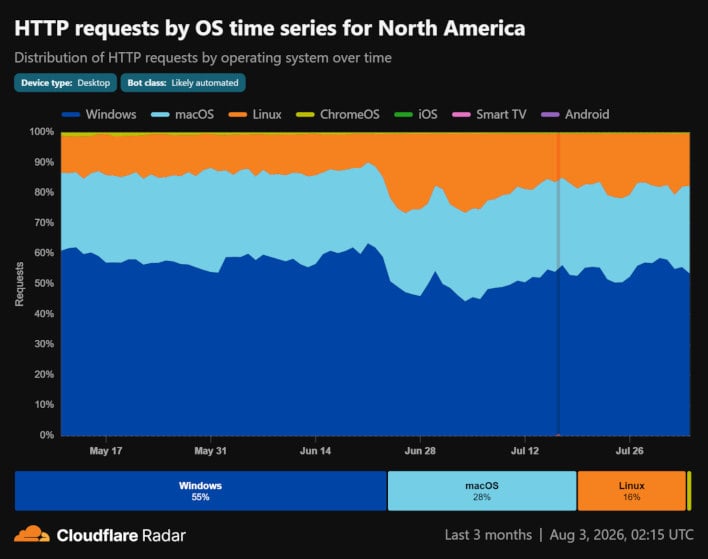
Also consider that StatCounter has previously had to retract and correct some of its numbers. This includes an incident in 2015 where StatCounter reported a surge in Windows 7 market share from 0.88% to 9.61% in October of 2025. While it makes for a tantalizing headline, the retraction invalidates the number, which had to be the result of some kind of systemic error. Windows 7 was no longer distributed or even supported by the majority of devices at the time.
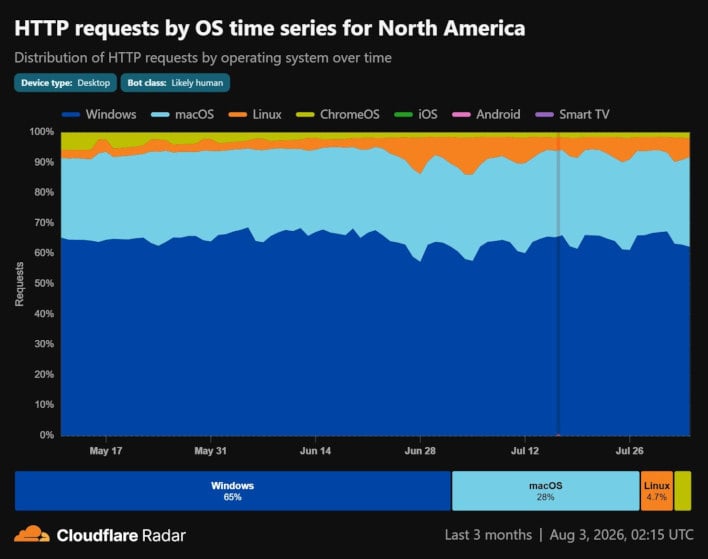
Regarding today's Linux numbers, CloudFlare Radar provides the smoking gun against the argument for a surge in human Linux adoption. By filtering for human traffic only, Linux's market share falls to 4.7% while Windows drops by only a single point to 65%. CloudFlare also seems to count macOS and OS X together, putting Apple's desktop market share at about 28%. Windows Latest acknowledges that CloudFlare Radar's numbers will also have some margin of error, but they do more accurately reflect the PC market at this point in time.
Image Credit: StatCounter, CloudFlare Radar (via Windows Latest)




