



Nova Lake Leak: When To Expect Intel's 52-Core Monster Gaming CPU


This slide, posted by Алексей (@wxnod on Xwitter), seems to be from a vendor presentation somewhere in mainland China. On the right side of the slide, you can clearly see a release timeline that barely needs translation: Nova Lake-S will enter mass production at the end of this year, the first models will go on sale in Q1 of next year (2027), and then throughout 2027 we'll see additional models releasing including, potentially, the launch of the Razor Lake series in late 2027.

Most of what's here isn't actually new. We had already heard that Intel would be launching with the 28-core processors first, with the dual-compute-tile models with up to 52 cores coming later in the year. We also had already heard some of the other information on the slide, including the news that the LGA 1954 platform would support multiple generations of upgrades, and that the platform would continue to use LPDDR5.
It's pretty unusual; Intel normally leads with its fastest SKUs and then backfills the lower-end parts. In this case, there's a fairly clear reason why the company isn't coming out of the gate with its biggest guns for the Core Ultra 400 series, and it comes down to the challenge of manufacturing those parts. To achieve 52 cores on the top-end Nova Lake CPUs, Intel is going to be equipping those parts with two compute tiles, something it has never done on consumer desktop CPUs before.
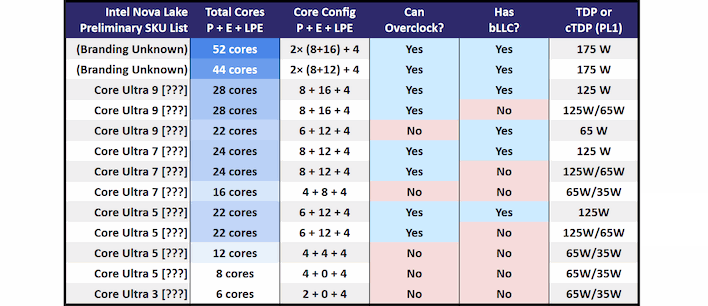
Launching the single-tile chips first allows Intel to present credible competition for AMD in the gaming arena while likely also competing well against AMD's extant Zen 5 chips in multi-core as well, and then once AMD launches its Zen 6 desktop CPUs with up to 24 cores, Intel can drop the dual-compute-tile beasts that we expect will roundly outpace the new AMD chips in multi-core workloads purely on the strength of core count alone.
Of course, it's not just CPU cores that determine multi-core performance; even with just 16 cores on current AMD chips and 24 cores on current Intel parts, we already see strong multi-core scaling in some workloads from increasing memory transfer rates. It's possible Intel's 52-core beasts will end up badly bottlenecked by their DDR5 memory interfaces. It'll be fascinating to see, for sure, but we've got a long while 'til those parts come around.





