



Intel Arrow Lake Refresh Arrives Soon As ASUS Pushes BIOS Support For These Motherboards


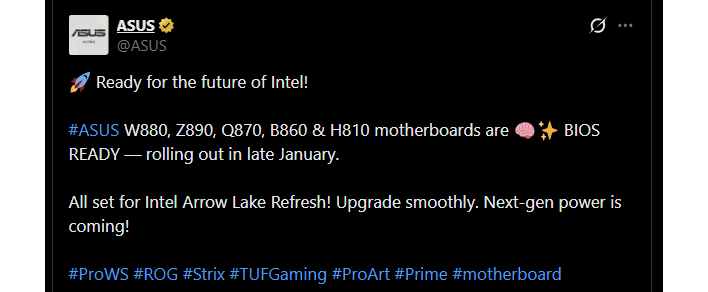
In a Xweet this morning, ASUS announced that its extant motherboards for the LGA 1851 platform—that's the CPU socket for Intel's Core Ultra Series 2 processors, better known by their codename Arrow Lake—are "BIOS Ready" for Intel's forthcoming refresh of that very same CPU family. That means that folks who already have such a system don't have to worry about buying a new motherboard to upgrade to a new CPU.
Of course, how new that CPU actually is is debatable. After all, the product family is being described as a refresh, which implies that it's fundamentally the same product, just revamped in some way. From what we've seen, that's probably going to mean slightly higher core clocks and little else; the earlier rumor that Intel was replacing the aging NPU2 neural accelerator used in the extant Arrow Lake parts has been debunked.
The change we'd really like to see in the Arrow Lake Refresh processors is a major uplift in fabric (D2D) and uncore (NGU) clocks. You see, while the Core Ultra Series 2 parts offer fantastic performance in productivity and creative workloads, their gaming performance is, in a word, bleak. The latest-gen Intel CPUs generally fail to outrun Intel's previous two generations of Raptor Lake desktop CPUs, and they even lose to AMD's aging Ryzen 7 5800X3D in some gaming results.
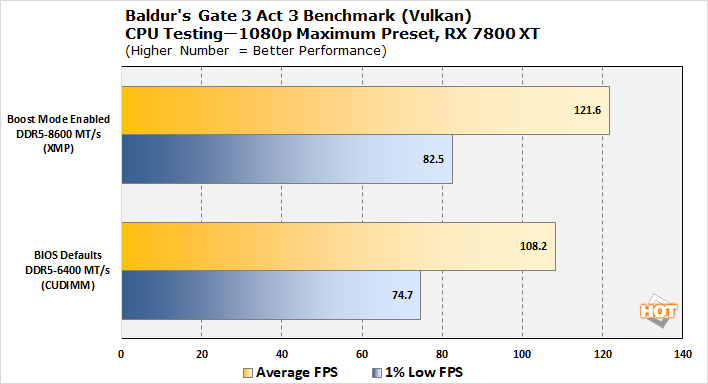
Enthusiasts have largely narrowed this down to poor memory performance resulting from the chiplet architecture of the CPUs; ramping the fabric (D2D) and uncore (NGU) clocks helps with this considerably, and Intel did exactly that with its Core Ultra 200S boost mode—although said mode requires high-end memory that few users will want to spend out for at this point given the extreme memory shortage happening right now. Also, it's important to be realistic about the gains; Core Ultra mostly catches up to Intel's last-gen, but it's still left in the dust by competitor AMD's 3D V-Cache CPUs, specifically in gaming.
Still, Arrow Lake was a huge uplift in power efficiency from Raptor Lake, and it also doesn't have the much-publicized reliability problems that those CPUs suffer. They're solid chips for any use case short of high-end or competitive gaming, and if Intel can cut prices with the second generation, they could make for some compelling deals. ASUS' Xweet doesn't tell us when Arrow Lake Refresh is coming, but considering that it's apparently rolling out the refresh-ready BIOS updates in "late January," we reckon it won't be long now.





