



Humanoid Robot Shatters Human Half-Marathon Record to Make History


Move aside mouth-breathers, an autonomous humanoid robot has bettered human runners at the Beijing Half Marathon by clocking a world-record time of 50 minutes 26 seconds. While it's not time to hang up your shoes just yet, the future of the sport could involve less electrolytes from Gatorade and more from lithium-ion batteries.
The star of the event, a bipedal model made by smartphone-maker Honor, crossed the finish line of the 13.1-mile course faster than the previous world record set by Jacob Kiplimo of Kenya (50:26 versus 57:20). Second and third place were also held by Honor autonomous units that finished in 51 and 53 minutes respectively.
No doubt, spectators and runners watched in a mix of awe and mild existential dread as the machine (along with other robotic entrants on a separate track from humans) was unaffected by humidity or the lactic acid buildup, pounding away to a major upset. Unlike its carbon-based competitors, the robot didn't need to pace itself or visualize a finish line; it simply executed its job at an average 15 mph pace.
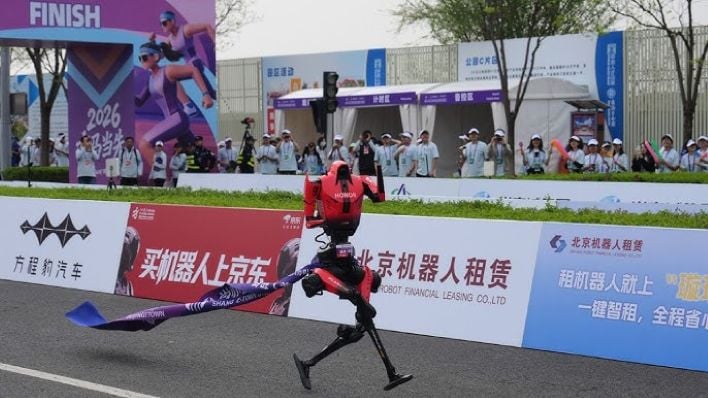
While the Honor robot was seen stumbling around a bit at the starting line, it looked almost invincible once in motion,. Other entrants were not as imposing, but as a whole, China continues to make huge strides (sorry, we had to go there) in the autonomous robotics arena. To wit, last years best finisher at the same event came in at 2 hours and 40 minutes.
Of course, the outcome of the race will reignite the conversation of ethical and competitive implications within the sporting world. We're quite certain that even among the cheering crowd, there were those who felt that the presence of machines devalue the human struggle inherent in long-distance running. This is regardless of the event organizers having the mechanical class race in their own designated lane to avoid physical interference with the human athletes.
It's clear that this milestone proves that hardware limitations that once held back humanoid robots are rapidly evaporating. It will be interesting to see how much wider the gap between human and machine performance will be next year as algorithms and hardware improve... Just as long as they don't militarize the tech, we're good.
Main photo credit: New China TV (via YouTube)





