Hubble Captures A Dying Star’s Final Breath In Spectacular New Image
by
Aaron Leong
—
Thursday, February 12, 2026, 11:13 AM EDT
NASA's trusty old Hubble Space Telescope has captured the death throes of the youngest and closest pre-planetary nebula from us, offering the most detailed view yet of the Egg Nebula's outflows of glowing gas, light, and dust.
This newly processed image from the NASA/ESA Hubble Space Telescope is the clearest view yet of the Egg Nebula. (Credit: ESA/Hubble & NASA, B. Balick [University of Washington])
The newly released image (above) centers on the enigmatic Egg Nebula (CRL 2688), located roughly 1,000 light-years away in the Cygnus constellation. While most nebulae are famous for their glowing ionized gases, the Egg Nebula is in a fleeting pre-planetary phase that lasts only a few thousand years. During this brief window, the star is not yet hot enough to make the surrounding gas glow on its own. Instead, it acts like a cosmic lighthouse: the central star (or the "yolk") is buried deep within a dense cocoon of dust, but its light escapes through structural holes to illuminate vast, concentric rings and polar lobes like searchlights piercing a foggy night.
These ripples are essentially a fossil record of the star's final centuries. Approximately every few hundred years, the dying star underwent a sputtering event, ejecting thin shells of material into space. Hubble’s sensors revealed that these shells are remarkably symmetrical, forming nearly perfect arcs expanding outward.
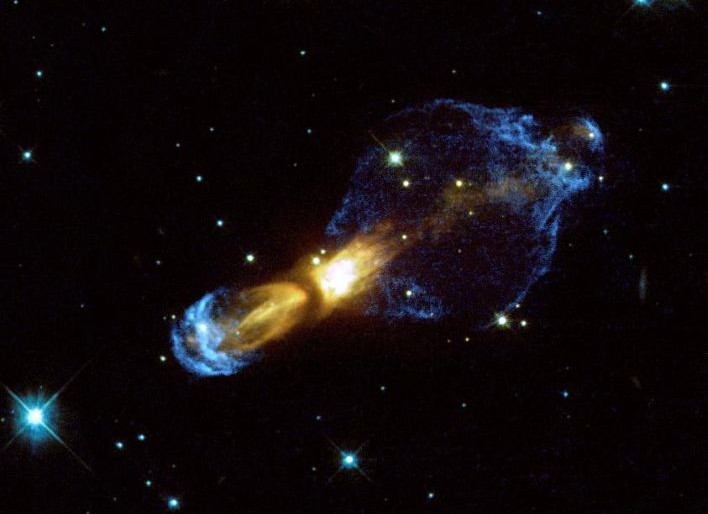
Beyond its visual beauty, the Egg Nebula sits between the Asymptotic Giant Branch (AGB) phase, where a star swells into a red giant, and the eventual creation of a glowing planetary nebula. In the coming millennia, the egg will metaphorically hatch: the central star's core will shrink and become so hot that its UV radiation will ionize the surrounding gas, causing it to fluoresce in brilliant neon colors.
Rotten Egg nebula: another example of a pre-planetary process. (Credit: NASA/ESA & Valentin Bujarrabal)
Aged stars like the one in the Egg Nebula are the universe’s primary recycling centers. The carbon-rich dust being blasted into space is the same type of material that eventually coalesces into new stars and rocky planets. By comparing this latest data with Hubble observations from 2012 and earlier, scientists are able to track the evolution of these dusty shells in real-time. Calculating the exact speed of the stellar winds and the frequency of the star's final gasps can help refine our models for how our own Sun will one day seed the surrounding cosmos.