



How To Watch Venus Vanish Behind The Moon In Broad Daylight


To start, begin looking roughly 38 degrees away from the sun. Look for the razor-thin, three-day-old waxing crescent moon, which is only about 11% to 14% illuminated. Venus itself will be quite brilliant at -4.0 magnitude. While those with exceptional vision and exact coordination might catch a glimpse of Venus as a tiny white speck against the blue backdrop, using binoculars or a telescope will drastically improve the odds. Using optics ought to reveal the jagged, dark, unlit edge of the lunar crescent slowly swallowing the solid white disk of Venus.
Do remember that since the moon and Venus are positioned relatively close to the sun, looking directly at the sun, even for a split second through binoculars or a telescope, can cause permanent damage. A safe technique is to set up your equipment in the physical shadow of a building or roofline so the sun is entirely blocked from view while the target area of the sky remains visible.
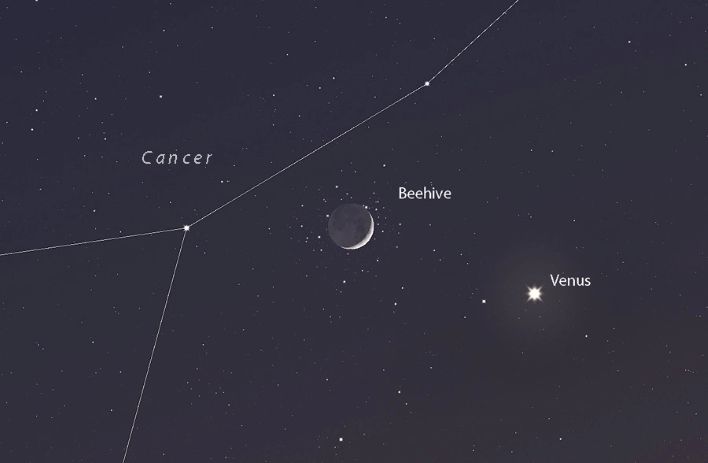
If daytime tracking proves too difficult, there's a more relaxed display available once twilight fades. At about 45 to 60 minutes after the sun sets, the crescent moon will guide stargazers to the Beehive Cluster (M44) in the constellation Cancer. Located just a few degrees from the moon, this faint patch of light transforms under binoculars into a shimmering swarm of dozens of blue-white stars.
Main image credit: NASA / Gineys





