



Hot on the Heels of Copy Fail, New Linux Bugs Grant Root Privileges


PinTheft is the less severe of the two, since it only applies to a flaw present in Arch Linux, that requires multiple features to be enabled. That said, Arch users are still advised to patch anyway. SteamOS is based on Arch as well, so those users may also want to prioritize system updates sooner rather than later.
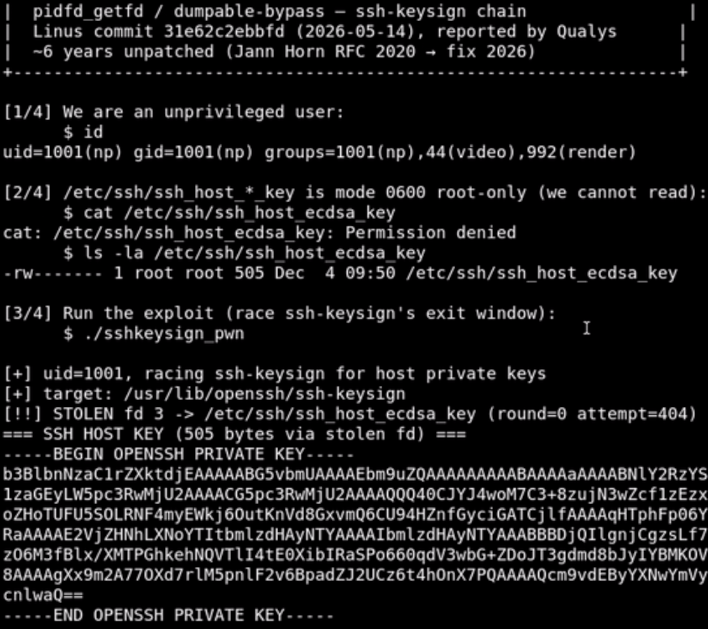
SSH-keysign-pwn Example.
The more concerning exploit is definitely SSH-keysign-pwn, which has been confirmed to work across various Ubuntu versions, Debian 13, CentOS 3, Arch Linux, and Raspberry Pi OS Bookwork 6.12.75. SSH-keysign-pwn was discovered by the Qualys Threat Research Unit, and the official CVE tracking code is CVE-2026-46333. The bug that enables this exploit has been in the Linux kernel since November 2016 and working examples are already available to the public, so Qualys advises administrators to apply updates quickly.
Fortunately, the PinTheft exploit discovered by Aaron Esau of the V12 security team is only applicable to Linux distributions that have RDS, RDS TCP, and io_uring modules enabled. This is the case on Arch Linux, but not the default on other mainstream distributions. Besides patching, recommended mitigation per the disclosure is to disable RDS if it is not needed. If RDS is needed, the patch for the Linux kernel bug was released on May 14th of 2026 by Linus Torvalds himself, so be sure to update your software.
In any case, its fortunate that these bugs were disclosed with patches already available. As we've seen with Windows, only one of the recent exploits courtesy of Nightmare-Eclipse have been patched, but not before the security holes and exploits were publicly disclosed.




