



CrystalDiskInfo Fights Fake Samsung SSD Market With New Clone Detection Feature


For years, counterfeit storage was easy to spot. The drives would immediately choke under the lightest workloads or report wildly inaccurate capacities, obviously marking them as fake. The recent wave of fake Samsung 990 Pros is a different beast entirely. These drives utilize aggressive SLC caching and third-party Maxio controllers to actively spoof early sequential read and write tests. To the untrained eye, and to many standard benchmarking utilities, they look like the real deal for the first few minutes of use, only to inevitably tank to abysmal speeds once the cache fills up.
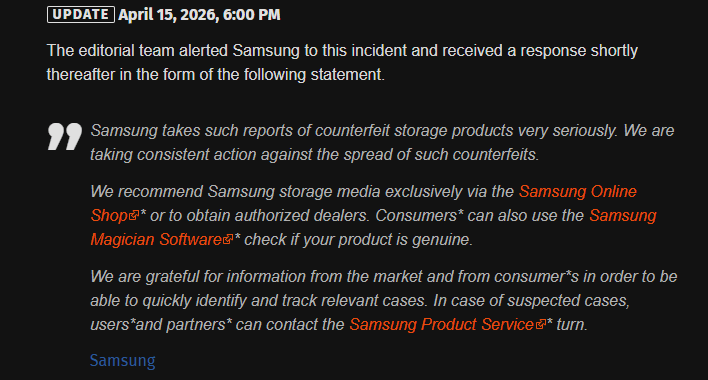
Until now, the only surefire way to verify a drive's authenticity was to download Samsung's proprietary Magician software, which checks the drive's firmware and flags unauthorized hardware. While effective, not every enthusiast wants to install brand-specific management software just to run a health check. For its part, Samsung itself is acutely aware of the knockoff plague. In a statement provided to German tech site ComputerBase, the company emphasized that it takes reports of counterfeit memory products "very seriously" and is taking "consistent action against the distribution of such counterfeits." The hardware giant recommended that consumers only buy storage media directly from the official Samsung online shop or authorized retailers, pointing users back to its Magician software to verify authenticity.

So, enter the new CrystalDiskInfo update. According to hiyohiyo's post, the utility can now automatically cross-reference the drive's reported hardware ID and firmware strings against known authentic Samsung configurations. When the software detects the telltale signs of a knockoff, such as a mismatch between the reported NVMe controller and the expected proprietary Samsung Pascal chip, or generic dummy firmware like the infamous 8888888 string, it will throw up a "[FAKE]" label directly in the user interface.
This is a solid quality-of-life win for the PC building community. CrystalDiskInfo is already the go-to lightweight utility for checking drive health, temperatures, and SMART data, so integrating counterfeit detection directly into a tool that many enthusiasts already run on a fresh PC build removes a major hurdle in catching these scams before the return window closes. Of course, the golden rule of PC hardware still applies: if a deal looks too good to be true, it probably is. Stick to reputable retailers, avoid sketchy third-party sellers on major marketplaces, and the second that new drive hits your motherboard, fire up CrystalDiskInfo to make sure you got what you paid for.





