



China Pulls Off Historic Orbital Rocket Sea Net Landing To Challenge SpaceX


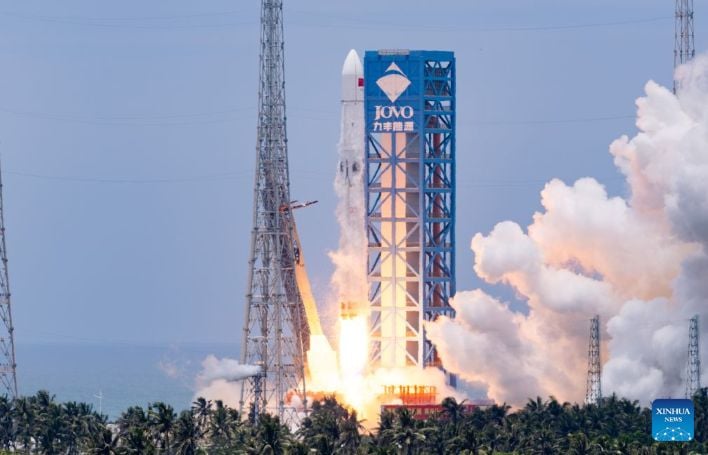
China has successfully recovered an orbital rocket booster via controlled descent for the first time, breaking what some see as the long-standing monopoly held by American commercial aerospace. During the maiden flight of the Long March 10B earlier today, the state-owned China Aerospace Science and Technology Corporation (CASC) achieved a flawless vertical return onto a sea-borne net platform.
At 12:15 p.m. local time from the Hainan Commercial Space Launch Site, the 207-foot (63-meter) tall, two-stage rocket lifted off, sending its satellite payload into a designated low-Earth orbit. At t-plus six minutes, the kerosene and liquid oxygen-fueled first stage separated from the upper stage. Here, the booster successfully performed a controlled, vertical descent, and navigated directly toward a specialized sea-based recovery platform.https://t.co/jtCmasw3Y0 pic.twitter.com/ZsbVRk6FS0
— Andrew Jones (@AJ_FI) July 10, 2026
Compared to SpaceX’s Falcon 9 that relies on deployable landing legs touching down on ground pads or drone ships, the Long March 10B utilized a net-capture system. As the booster neared the ocean platform, it deployed four structural landing hooks that caught a highly tensioned net structure. According to the China Academy of Launch Vehicle Technology (CALT), this system eliminates the heavy weight of traditional landing legs, simplifying the rocket's architecture while broadening the safety margin for landing-point deviations.
The Long March breakthrough comes amidst a hyper-competitive global space race. We don't think the launch will erase the lead held by U.S. reusable systems, but the gap is narrowing fast. China’s state program and an emerging ecosystem of domestic private entities, such as CAS Space and Galactic Energy, are aggressively accelerating their reusable programs to match SpaceX’s feverish operational tempo. CASC officials have already announced plans to clean, inspect, and refly the same Long March 10B booster before the end of the year.





