



China Builds Hypergravity Machine That Creates 100× Earth’s Gravity In A Lab


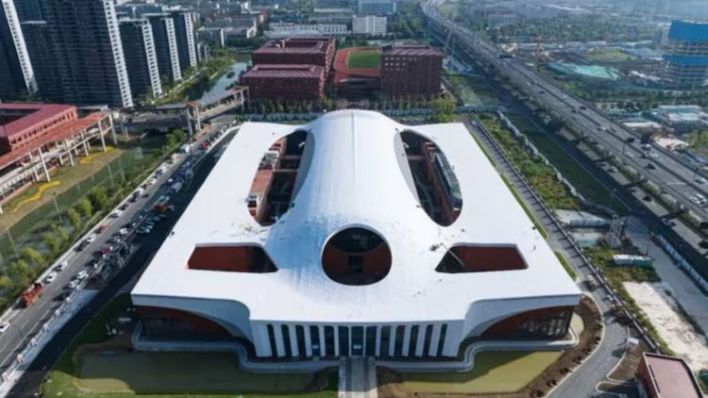
The machine, officially known as CHIEF1900, was delivered to Zhejiang University on December 22. Built by the Shanghai Electric Nuclear Power Group, this massive centrifuge is the centerpiece of the Centrifugal Hypergravity and Interdisciplinary Experiment Facility (CHIEF). Located 50 feet (15 meters) underground in the city of Hangzhou to shield it from external vibrations, the facility represents a 2 billion yuan ($285 million) investment into physical science research and testing.
Per its namesake, CHIEF1900 possesses a capacity of 1,900 g-tonnes, surpassing the previous world record held by its predecessor, the CHIEF1300, and dwarfing the 1,200 g-tonne centrifuge operated by the U.S. Army Corps of Engineers. To put it in perspective, while a standard household washing machine generates about 2g of force during a spin cycle, this machine can subject multi-tonne samples to forces 100 times greater than Earth’s gravity.
Beyond infrastructural testing, CHIEF1900 also allows scientists to fast-forward through time. Geological processes that take tens of thousands of years, such as the migration of pollutants through deep soil or the resonance of high-speed train tracks with the ground, can be observed in a faction of that time. As Chen Yunmin, the project’s chief scientist, explained, "We aim to create experimental environments that span milliseconds to tens of thousands of years, and atomic to [kilometre] scales – under normal or extreme conditions of temperature and pressure."
Obviously, constructing such a machine required overcoming some major technical hurdles. At peak speeds, the friction and mechanical movement generate extreme heat that threatens to melt internal components. To solve this, the team engineered a sophisticated vacuum-based cooling system featuring the world’s largest flange diameter, combined with glacier coolant and forced-air ventilation.





