



CES Expected To Usher In Game-Changing TV Tech For 2026


CES 2026 will be the launching pad for lots of new hardware, including a new wave of enhanced Mini LED TVs, which manufacturers are branding in a variety of ways. Some companies will call them "true color TVs", while others are being more literal -- like Hisense -- and calling out RGB Mini LED technology specifically, or using the Micro RGB moniker, like Samsung and LG. Sony just calls it "True RGB", but ultimately all of these manufacturers are referring to the same thing—an advancement in Mini LEDs.

Understanding RGB-MiniLEDs is pretty straightforward. Whereas legacy Mini LED panels use a single Mini LED per-pixel (starting from a neutral blue or white that is shifted to the desired color), RGB Mini LED has a dedicated red, green, and blue LED pixels. These RGB Mini LEDs are smaller than the ones used in current Mini LED panels, so it makes Samsung and LG's "Micro RGB" naming fairly sensible, too. Having dedicated RGB pixels that can be altered individually results in improved color accuracy, contrast, and brightness over current Mini LED technology. Some Mini LED panels were already considered competitive with OLED in terms of color accuracy and many were outright superior to OLED in terms of brightness, so RGB Mini LEDs should be even more attractive.
There are still some kinks to work out with RGB-MiniLEDs, however. Hisense already offers the 116UX TriChrome Mini-LED TV, a hulking 116-inch behemoth that cost a whopping $25,000. While CES 2026 will feature newer, smaller sets leveraging the technology, pricing many remain high versus more mature OLEDs. Reviews of that $25K HiSense RGB MiniLED TV were also fairly mixed, with critics (including LinusTechTips and The Display Guy) pointing out poor handling of local dimming and fast motion compared to OLEDs. Those are things that will surely improve with some maturity, though.
In any case, having more options for consumers is almost always a good thing, especially if it helps drive down the cost of leading technologies. For now, we remain cautiously optimistic for the upcoming display war between RGB-MiniLED and OLED, and are looking forward to checking out the many new TVs at CES 2026.
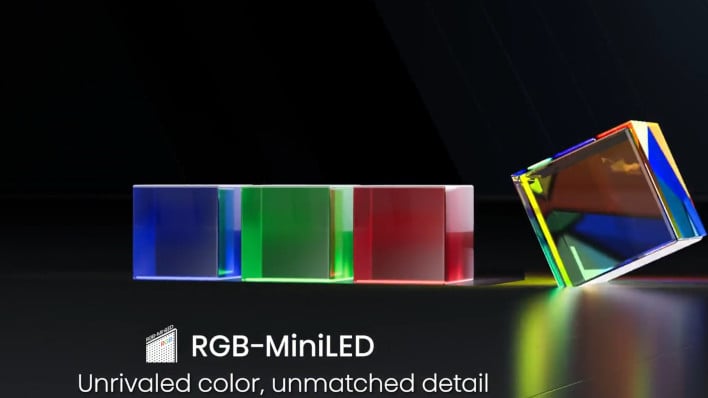
Understanding RGB-MiniLEDs is pretty straightforward. Whereas legacy Mini LED panels use a single Mini LED per-pixel (starting from a neutral blue or white that is shifted to the desired color), RGB Mini LED has a dedicated red, green, and blue LED pixels. These RGB Mini LEDs are smaller than the ones used in current Mini LED panels, so it makes Samsung and LG's "Micro RGB" naming fairly sensible, too. Having dedicated RGB pixels that can be altered individually results in improved color accuracy, contrast, and brightness over current Mini LED technology. Some Mini LED panels were already considered competitive with OLED in terms of color accuracy and many were outright superior to OLED in terms of brightness, so RGB Mini LEDs should be even more attractive.

There are still some kinks to work out with RGB-MiniLEDs, however. Hisense already offers the 116UX TriChrome Mini-LED TV, a hulking 116-inch behemoth that cost a whopping $25,000. While CES 2026 will feature newer, smaller sets leveraging the technology, pricing many remain high versus more mature OLEDs. Reviews of that $25K HiSense RGB MiniLED TV were also fairly mixed, with critics (including LinusTechTips and The Display Guy) pointing out poor handling of local dimming and fast motion compared to OLEDs. Those are things that will surely improve with some maturity, though.
In any case, having more options for consumers is almost always a good thing, especially if it helps drive down the cost of leading technologies. For now, we remain cautiously optimistic for the upcoming display war between RGB-MiniLED and OLED, and are looking forward to checking out the many new TVs at CES 2026.




