



Backyard Scientist Is Making RAM at Home in a Memory Shed Fab


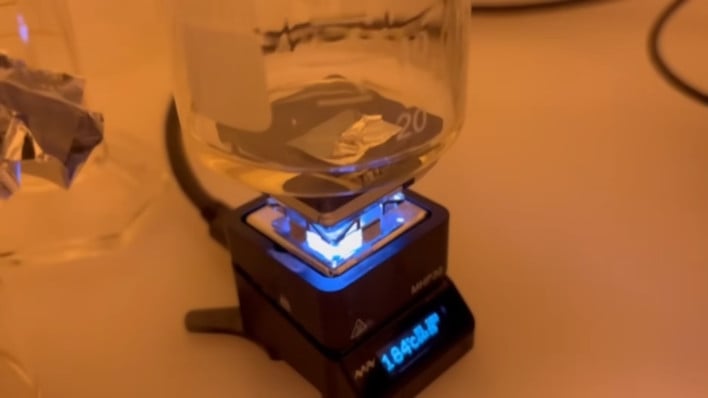
Following UV exposure to project a design mask onto the surface, a solution is used to wash the silicon and begin forming transistors. Testing the transistor's voltage allows Dr Semiconductor to tune the transistors for the on/off operations needed for memory cells, though he does point out that this will require operating voltages to be kept low, noting the difficulty of scaling up these operations. The end of his process only nets a few DRAM cells, which he notes as the first time DRAM cells have ever been made at home.
Sadly, the process has not yet birthed a fully-fledged RAM stick that can be used within a PC. That part is coming up next in a future video, but having proven that individual RAM cells can be DIYed, Dr Semiconductor believes that once he stitches together enough of these cells into a large array, he should be able to hook it up to a PC.
He also alludes to the possibility of running DOOM on the final product, though since DOOM was originally released in 1993 with a minimum official requirement of 8MB RAM, this may not mean we'll be seeing commercial-grade DIY memory at the end of this project. It would be yet another milestone for playing DOOM with unexpected hardware, though, the latest milestone on that front being human neurons.
It's still a fascinating first, though, and has earned a large wave of positive reception due to the sheer ambition of the project. Sadly, while it likely does mean that not even Dr Semiconductor can DIY his way out of the current RAM shortage, it does lend some credence to the idea that the existing triple monopoly of memory manufacturing maintained by Micron, Samsung, and Hynix may actually be breakable. One can hope, anyway.




