



ASUS Cites Customer Confusion And Not Scratched PCBs For Another Q-Release Redesign


ASUS has confirmed that it tweaked the design of its Q-Release PCIe mechanism on every new Neo motherboard coming out this year, including both high-end models with more premium designs and entry-level options. The official reason for the redesign, however, is not because of reported issues with the previous design leaving scratch marks on some graphics cards, but due to customer confusion.
In a video posted to YouTube, Juan Jose Guerrero, Manager of PR and Partnerships at ASUS North America, outlines the revised design that brings back a physical element to the quick release mechanism.
"In the prior generation, we had our Slim design, which I really loved—it didn't actually require any buttons. For some users, they were confused by this, and there was also, for some individuals, they felt that they wanted essentially that reintroduction of a physical mechanism. So we have gone ahead and reincorporated a physical mechanism on the boards," Guerrero explains.
Going back to right around this same time a year ago, ASUS had responded to complaints of its button-less Q-Release Slim design purportedly resulting in minor physical damage to the PCB on graphics cards, with users reporting scratch marks on the gold contacts after multiple installations and removals. Then around a week later, ASUS blamed the situation on user error and posted official guidance on how to properly remove a GPU from a Q-Release Slim motherboard without damaging it.
"The correct insertion and removal method is indicated in the user manual and select motherboard product packaging[...]"In our internal testing and evaluation of the extremely small number of cases reported we found no damage to the motherboard or graphics card that would affect functionality or performance. However, it is important to emphasize that any type of PCIe add-in card will exhibit signs of usage and wear marking after 60 continuous insertions and removals," ASUS said at the time.
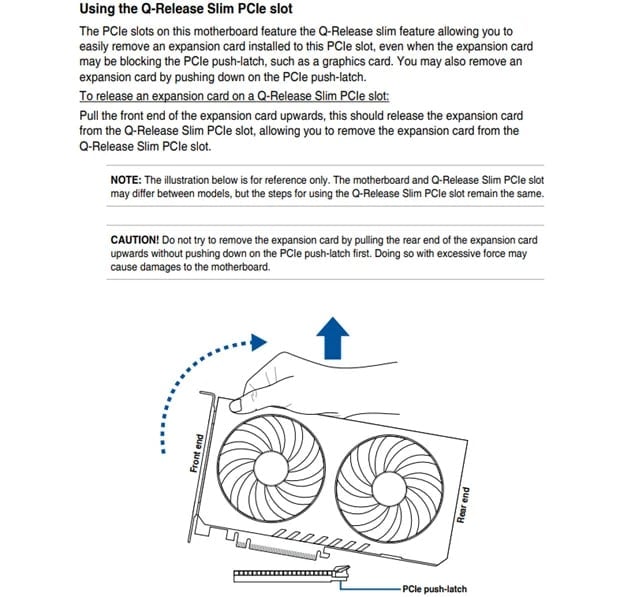
Official guidance for the Q-Release Slim mechanism is to pull the front end of an expansion card upwards, which then releases it from the PCIe slot. ASUS does acknowledge that some wear and tear is inevitable after several dozen insertions and removals, but that shouldn't affect the vast majority of users.
Regardless, ASUS is bringing back a physical button system to essentially reject (partially) a card from the Q-Release PCIe slot. This could actually make GPU removals a little trickier, as buttons and latches can sometimes be blocked from easy access, hence why ASUS went with a button-less design in the first place. We'll have to wait and see if latest revision prevents users from scratching up their expansion cards.




