



Apple's 18-Core M5 Max Topples 32-Core M3 Ultra In Early Benchmarks


Regardless of how you may feel about Apple as a company, you have to tip your hat at Tim Cook and the crew for making some impressive strides in their in-house chip designs. The latest evidence of this can be seen in preliminary benchmarks for Apple's fresh-out-of-the-oven M5 Max that is one of the chip options on the latest-generation MacBook Pro. Over on Geekbench, leaked results indicate that it's not only the fastest chip Apple ever designed, it also comes out ahead of the latest x86 chips by AMD and Intel.
Naturally, caveats abound with this sort of thing. For one, these are leaked results and must be viewed as unofficial. Secondly, Geekbench is certainly not the end-all, be-all when it comes to evaluating performance. Geekbench results are useful in a broader context when other benchmarks are also thrown into the mix, but by itself, Geekbench doesn't tell the full story. So go ahead and lower the pitchforks and torches.
For now, some early benchmark data at Geekbench's database is the only thing we have to go on for the M5 Max, and viewed from that singular lens, Apple's latest chip looks strong. Have a look...
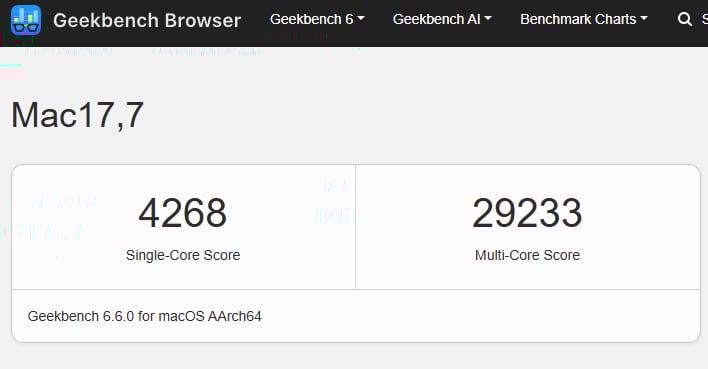
Barring spoofed shenanigans, the entry is for Apple's refreshed 16-inch MacBook Pro configured with the M5 Max and 128GB of unified system memory. It shows the chip scoring 4,268 in the single-core test and 29,333 in the multi-core test.
Starting with the single-core result, the 4,268 score tops Geekbench's collection of average scores for all AMD and Intel x86 contenders, the fastest of which is the Ryzen 9 9950X3D with a 3,395 score.
Switching to multi-core score rankings, the M5 Max's 29,233 positions it in second place among x86 contenders, ahead of AMD's Ryzen Threadripper Pro 9975WX (27,895) and below the Ryzen Threadripper 9985WX (31,341) that sits atop the chart.
For various reasons, it's problematic to draw too much of a conclusion when comparing Apple's Arm-based silicon to x86 chips from AMD and Intel in Geekbench. Fortunately, Geekbench also maintains a separate ranking of Mac benchmarks, and the M5 Max shines there as well.
The 4,268 single-core and 29,299 multi-core scores would place the M5 Max at the top in both categories if they hold up. Equally impressive is how the 18-core M5 Max stacks up against the 32-core M3 Ultra in this Mac Studio benchmark run from last year. The M3 Ultra scored 3,247 in the single-core test and 28,169 in the multi-core test.
Compared to those results, the MacBook Pro with its M5 Max chip posted a 31.4% faster single-score score and a 4.1% faster multi-core score. The latter is actually more impressive to us, given the disparity in cores. It also bodes well for the eventual M5 Ultra, if such a chip is in Apple's cards.




