



Apple Unveils MacBook Pro With M5 Pro And M5 Max To Supercharge On-Device AI


Apple CEO Tim Cook promised this would be a "big week" for the Cupertino company, which has already seen the launch of a new iPad Air with M4 silicon and an A19-powered iPhone 17e. Now a day later, Apple has introduced a refreshed MacBook Pro powered by its new M5 Pro and M5 Max chips built on an also-new Apple-designed Fusion Architecture.
"This innovative design combines two dies into a single system on a chip (SoC), which includes a powerful CPU, scalable GPU, Media Engine, unified memory controller, Neural Engine, and Thunderbolt 5 capabilities," Apple explains.
Apple's approach to the M5 Pro and M5 Max differ from the previous generation M4 Pro and M4 Max variants that basically fused two and four chips, respectively. In contrast, Apple's in-house designed Fusion Architecture connects two third-generation 3-nanometer dies into a single SoC using advanced packaging.
The new M5 Pro and M5 Max models both tout up to an 18 -core CPU (compared to 16 cores on the M4 Max and 14 cores on the M4 Pro), which include 6 so-called super cores and 12 performance cores. According to Apple, the new chips deliver a CPU performance uplift of up to 30%. Apple's also claiming a 2.5x multi-threaded uplift when comparing to the M1 Pro and M1 Max.
Meanwhile the M5 Pro features up to a 20-core GPU with a Neural Accelerator in each core and support for up to 64GB of unified memory with a up to 307GB/s of memory bandwidth. All combined, Apple says the M5 Pro delivers 4x th peak GPU compared to the M4 Pro and over 6x compared to the M1 Pro.
The burlier M5 Max ups the ante with up to a 40-core GPU, along with support for up to 128GB of unified memory and up to 614GB/s of memory bandwidth. Apple's pitch is that these upgrades enable better on-device AI results when working with complex scenes, massive datasets, and higher token generation for LLMs.
"M5 Pro and M5 Max are a monumental leap forward for Apple silicon, leveraging our new Fusion Architecture to scale the capabilities of Apple silicon while preserving its core tenets of performance, power efficiency, and unified memory architecture," said Johny Srouji, Apple’s senior vice president of Hardware Technologies.
"Both chips underscore our relentless pace of innovation, integrating the world’s fastest CPU cores, a next-generation GPU with Neural Accelerators, a faster Neural Engine, and high-bandwidth, high-capacity memory — resulting in an unparalleled combination of performance, efficiency, and incredible on-device AI capabilities for MacBook Pro," Srouji adds.
Apple MacBook Pro Upgraded With M5 Pro And M5 Max
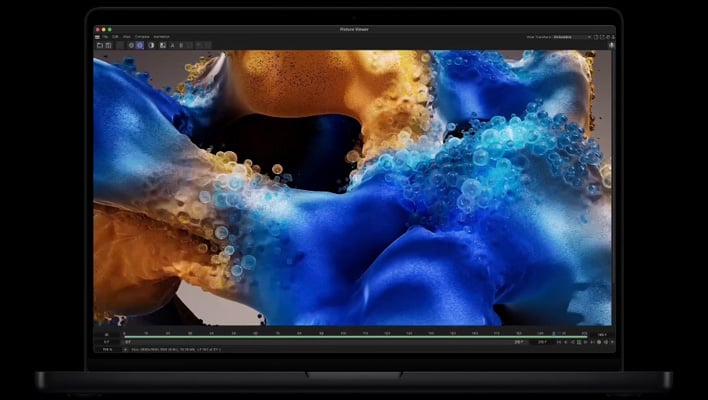
Apple also announced refreshed 14-inch and 16-inch MacBook Pro models that employ the latest M5 Pro and M5 Max silicon for "game-changing performance and AI capabilities." Much of that claim is centered on Apple's new chips, though there are other highlights.
The latest MacBook Pro models come with the promise of up to 2x faster SSD performance, starting at 1TB of total capacity. They also sport Apple's N1 wireless networking chip with Wi-Fi 7 and Bluetooth 6 support, Thunderbolt 5 connectivity, a 12-megapixel Center Stage camera, and up to 24 hours of rated battery life.
"MacBook Pro with M5 Pro and M5 Max redefines what’s possible on a pro laptop, now up to 4x faster than the previous generation," said John Ternus, Apple’s senior vice president of Hardware Engineering. "With Neural Accelerators in the GPU, the new MacBook Pro enables professionals to run advanced LLMs on device and unlock capabilities that no other laptop can do—all while maintaining exceptional battery life. Combined with even faster unified memory and storage, it empowers users to take their work even further, unleashing new possibilities and pushing the boundaries of what they can do."
According to Apple, the M5 Pro version of the MacBook Pro enables up to 7.8x faster AI image generation compared to the M1 Pro model and is 3.7x faster compared to the M4 Pro model; up to 6.9x faster LLM prompt processing compared to the M1 Pro model and a 3.9x uplift compared to the M4 Pro model; and up to 5.2x faster 3D render compared to the M1 model and a 1.4x uplift compared ot the M4 Pro model.
The M4 Max MacBook Pro delivers similar performance gains, according to Apple, with up to 8x and 3.8x faster AI image generation compared to the M1 Pro and M4 Pro models, respectively; up to 6.7x and 4x faster LLM processing; and up to 5.4x and 3x faster video effects rendering (in Blackmagic DaVinci Resolve Studio).
Pricing for the 14-inch MacBook Pro starts at $2,199 for the M5 Pro configuration and $3,599 for the M5 Max. The 16-inch MacBook Pro starts at $2,699 for the M5 Pro and $3,899 for the M5 Max. Both will be available starting Wednesday, March 4.




