


Startup Claims Its New Neural Rendering Tech Is Superior To NVIDIA's DLSS


Actually, Apex makes a lot of bold claims about ANR. In particular, the company's headline claim is that its ANR FG is a superior frame generation solution to DLSS-FG. Supposedly, ANR-FG is faster and offers higher image quality versus NVIDIA's DLSS frame generation, and the firm plans to beat NVIDIA in the areas of super resolution and ray reconstruction, too. No word on actual neural rendering like DLSS 5 though, despite the name.
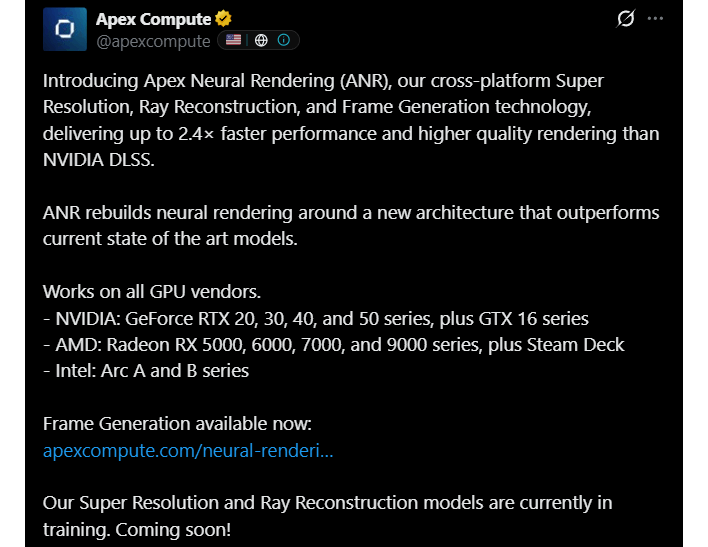
Not only that, but it claims to be able to do this on virtually any GPU made in the last seven years or so, going all the way back to the Radeon RX 5000 series, the GeForce RTX 20 series, and even the GeForce GTX 16 series, as well as the Arc A- and B-series GPUs and Apple Silicon graphics. This isn't as crazy as it seems; AI is fundamentally a compute workload, so anything that supports a modern compute interface should in theory be able to run whatever kind of AI workload, as long as you account for the disparate performance.
The firm has a beta preview download of its frame generation technology available, so I spent much of this morning trying it out on different hardware. Since it obviously isn't implemented in any games directly, it requires the Optiscaler mod to allow you to switch from another frame gen tech to ANR. Only, in my experience, it actually only supports games that are running DLSSG, which means you have to be able to select DLSSG in the game. Optiscaler's spoof can help with this on non-NVIDIA GPUs in theory, but in the limited time I had to mess with it, I wasn't able to get it working on AMD Radeon (RDNA 2 and 3) nor Intel Arc (B-series) GPUs.

I did get it working on a GeForce RTX 50 Series card, though. It's real, and it works. In fact, it works pretty well, too. I was initially unimpressed as I was seeing major artifacting in Hogwarts Legacy (above), but it seems the frame generator isn't compatible with the game's motion blur effect. Turning that off solved the artifacting and it looked great. Notably, DLSS FG doesn't care about the motion blur effect and has no UI artifacting with it on or off.
Even more notably, my results disagree with Apex's performance claims. In Hogwarts Legacy, in the Greenhouse test scene I was using, my test platform was delivering an average of 186.6 FPS with 2x frame generation while using ANR. Switching over to DLSS FG, the average frame rate increased to 201 FPS. That jump is smaller than it seems because we're comparing doubled frames, but it's still a reversal of Apex's performance claims as DLSS FG was still around 7% faster in my testing.
I didn't do exhaustive image quality testing, but subjectively speaking, in Hogwarts Legacy, the game looked quite nice, with smooth motion and no clear artifacts. With that said, I think it looked very good with DLSS FG, too. The firm has a couple of videos up on its YouTube channel illustrating DLSS FG versus ANR FG and I think Apex might be comparing against the earlier version of DLSS FG; I was comparing against the heavier Preset B version (by happenstance, as I simply had that set in the NVIDIA App already.) Visually they look very similar to me in the real-world, but frame generation artifacts are hard to notice in motion anyway.
Personally, I'm looking forward to a better installation method that doesn't require fiddling with Optiscaler, and the release of the company's own complete solution with upscaling and ray reconstruction. While ANR FG didn't quite live up to the firm's claims in my quick testing, it's real and it definitely works. A vendor-agnostic ML-powered upscaling and frame generation solution could be just the thing to get us out of this mire of vendor-specific solutions. Perhaps Apex should contact Microsoft about DirectSR.