


AMD Radeon GPUs Run Nearly Every NVIDIA DLSS Feature With New Mod


While DLSS-NR on AMD started out as it is named, functioning as a bridge to get NVIDIA's DLSS 5 Neural Rendering working on Radeon GPUs, in recent versions the developer has started adding support for other DLSS features, including Super Resolution, Ray Reconstruction, and most recently, Frame Generation. The tool also supports injection of AMD's own FSR 4.1.1 features, although ironically it doesn't actually support FSR Ray Regeneration yet.
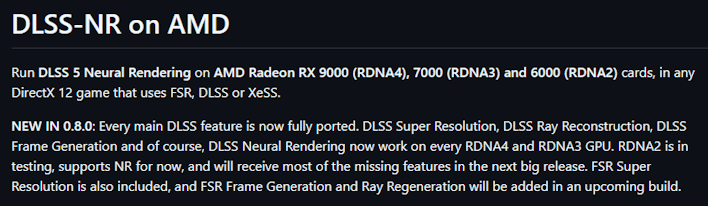
Unsurprisingly, this project features significant contributions from Anthropic's Claude assistant. Like many other recent "vibe-coded" projects, it's not clear how much of the work here is the developer's own and how much was done by Claude, but the developer claims it is a "ground-up, full reimplementation" of the DLSS runtime for AMD GPUs. To be clear, that's distinct from fully re-creating DLSS from scratch, and that's why the project still requires NVIDIA's DLSS libraries—it's still using NVIDIA's AI models.
Regardless, the developer says it currently works on Radeon RX 7000 and RX 9000 graphics cards, which would mean GPUs from the RDNA 3 and RDNA 4 families. RDNA 2 support is coming soon, supposedly; comically, that means that Radeon RX 6000 cards may get DLSS (albeit unofficially) before they get official support for AMD's own FSR 4. It apparently works, too; there are reports in the GitHub issues from users who have the project running in a variety of games, although most of them are concerning the original DLSS 5 functionality.

Beyond DLSS, the mod can also apparently mix in XeSS and FSR technologies, allowing users to mix and match. This isn't quite novel; Optiscaler has been allowing this kind of thing for a while. However, it does make us wonder why it has taken the community to implement this kind of feature. Historically, this is the sort of thing Microsoft would have stepped up to handle as part of DirectX. I suppose Microsoft is too busy trying to move everyone to Arm.
We haven't had time to test the project for ourselves, but if there's enough interest, we could pull some Radeon cards out of the pile and see how it works. Let us know if you'd like to see some benchmarks and IQ comparisons, or if you want to try it for yourself, head over to the project's GitHub page to grab the project files yourself.