



AMD's Zen 6 Architecture May Target In-Game Stuttering Issues


Famous Ryzen hacker 1usmus, the developer of DRAM Calculator for Ryzen and more recently the HYDRA OC application, has shed some light on a few new knobs exposed to the operating system and chipset software by the firmware for AMD's Zen 6 processors. Speaking to Videocardz, he says that AMD's Zen 6 processors have new capabilities, including Performance Priority and HighestFreq upgrades for CPPC, per-core EPP Boost, PQOS Global Bandwidth enforcement, and expansions to the IBS memory profiler.
A lot of this was known already; we reported on the IBS changes way back in December when AMD published the Performance Monitor Counters for Zen 6, and the new CPPC features have been known since at least March. We haven't talked about them, though, so let's go over what they are, and why we phrased our headline the way we did.

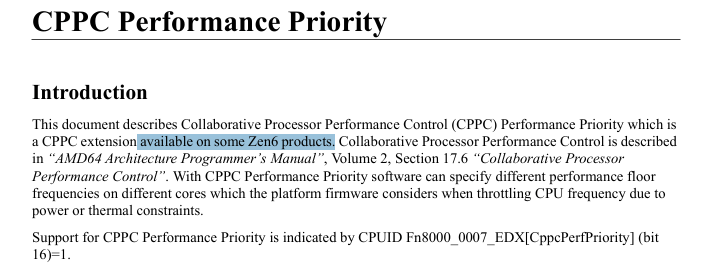
CPPC stands for "Collaborative Processor Performance Control," and it's not new at all. It's a part of the ACPI specification; your current PC uses it. The name tells you what it is, and the parts that are collaborating are the operating system (Windows/Linux) and the CPU firmware. There are two new features for CPPC in Zen 6: FloorPerf and HighestFreq. FloorPerf is exactly what it sounds like: the ability to set a floor on the performance of a given core. It can be set by software, and if used intelligently, could help keep CPUs from downclocking too much while latency-sensitive work remains active, even if the core isn't busy at that moment. This help avoids hitches that result in waiting on the CPU to clock up to its maximum frequency again.
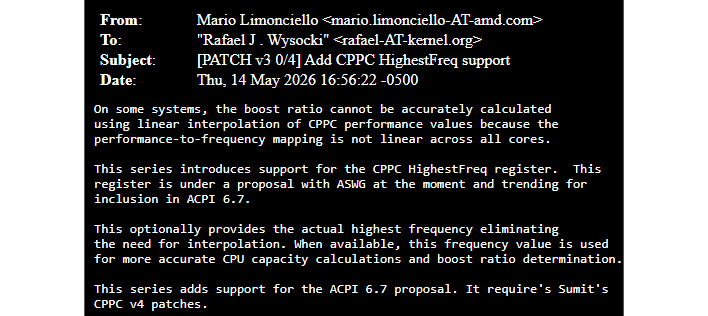
Meanwhile, "HighestFreq" lets the firmware explicitly tell the OS the maximum achievable clock rate on each core individually. CPPC already has a mechanism called 'Preferred Cores' where the firmware can signal to the OS which cores on the specific CPU you have are the best performers. This varies between individual CPUs due to tiny discrepancies in manufacturing. However, the operating system doesn't (currently) know clock rates, only relative values; it has to estimate clock rates based on the CPPC data. This update simply lets the OS know exact values.
The new per-core EPP Boost feature is arguably the most interesting part for our headline topic. Energy Performance Preference (EPP) is another CPPC parameter. Essentially, EPP is how the operating system tells the processor firmware how to behave, specifically with regards to the balancing act between performance and efficiency. A processor with a very low EPP value will boost faster, stay boosted longer, and generally prioritize latency. A higher EPP value will make the chip avoid unnecessary boosting, ramp clocks more slowly, and generally save power.
Having the ability to set this on a per-core basis is quite interesting because, as we were discussing in the beginning, modern chips have a lot of cores. Zen 6 is known to move to a twelve-core CCD, meaning that each CPU chiplet on next-gen Ryzen processors has twelve physical CPU cores. (They also have 48MB of L3, but more on that in a minute.) Modern processors are tightly governed according to their power and thermal limits, yet while downclocking one core to let another boost is the order of the day for mobile processors, it hasn't really been easy to do on desktop platforms to this point. Recently we reported on an EPP tweak for Linux that boosted 1% low frame rates on the Steam Deck by nearly 32%.
Finally, PQOS Global Bandwidth Enforcement is really more of an EPYC server CPU feature than a desktop Ryzen delight, but basically it allows the firmware to limit how much memory bandwidth individual threads are allowed to use. This could help avoid memory bandwidth bottlenecks for foreground threads, but those are very rarely an issue on client desktop tasks anyway.
A key point to understand is that all these new features are features of the Zen 6 platform firmware and processor interface, and that they won't necessarily be available or exposed on desktop Ryzen processors. Furthermore, these same functions are all available to Intel as well, since they're either part of or expected to be part of the next ACPI standard. We hope they will, but you never know. Altogether, we expect Zen 6 desktop CPUs to have excellent gaming performance with smooth 1% low frame rates, but that's probably got more to do with the rumored clock rates over 6.5 GHz and the 48MB of L3 cache than with specific power management firmware tweaks.





