



AMD Linux Patch Dramatically Reduces Game Stutters On Steam Deck


As the mastermind behind the patch, Meta employee David Vernet, puts it, "A game's main or render thread typically blocks briefly on a futex or GPU fence every frame, and the resulting frequency droop shows up directly as stale frames and inflated frame-time percentiles. [...] This series instead adds in an opt-in, per-core EPP boost."
So, Vernet found a relatively niche problem within AMD's Linux drivers, and found a fix that improves performance without triggering regressions in low-power SoC devices like the Steam Deck. The opt-in per-core EPP boost was found to be the best solution since testing revealed that raising the "min_perf" variable on a busy core resulted in performance regression since it also disrupted the System Management Unit's (SMU) shared CPU/GPU boost management.
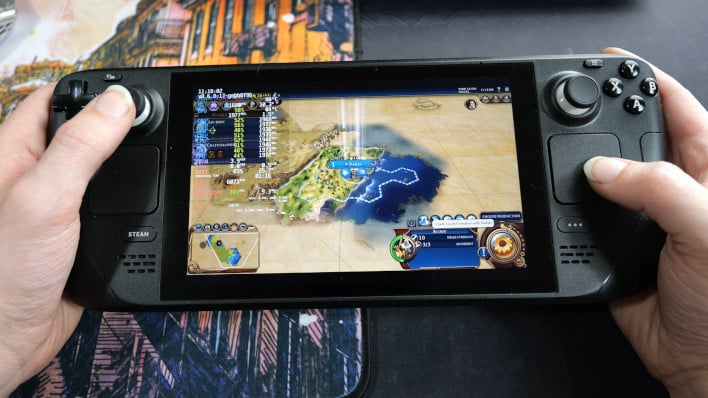
Civilization VI has ran well on Deck for a while, but eliminating major dips makes it near-perfect.
Per Phoronix, the end result of David Vernet's tweak improved Civilization VI's 1% low FPS by a whopping 31.8%, and improved overall frametimes by 4.1%. While Civ VI was already considered playable on the Steam Deck, this improvement virtually removes major framerate dips from the experience and makes regular gameplay just a bit smoother, too. Further games have yet to be tested with this tweak, though we'd expect it to similarly improve performance in CPU-bound titles on both the Steam Deck and other AMD-based handhelds.
Sadly, the patch has not yet been added to the mainline AMD Linux kernel, so users won't be able to test it out for themselves just yet. The promising results already shown do make it likely that it'll make its way in, though.
In the meantime, there are other great ways to improve the Steam Deck's performance, if you're so inclined: for example, undervolting the handheld to stabilize its performance and improve battery life.
Image Credit: XxViciousxX (Civ VI on Deck footage)




