



AMD Unveils Ryzen AI 400 Series For Next-Gen AI PC Power On AM5 Desktops


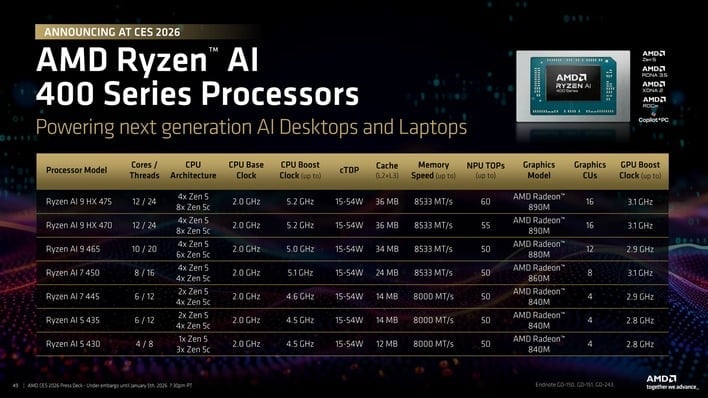
As a refresher, AMD announced the mobile Ryzen AI 400 chips at CES. Without putting too fine a point on it, these are refreshed versions of the Ryzen AI 300 family processors, codenamed "Strix Point." AMD barely gave them a footnote in its CES presentation, and it's easy to understand why; it's not that they're bad chips, they're just not really new. If you know Strix Point, you know Gorgon Point.
Krackan Point was essentially a shaved-down version of Strix Point that sacrificed four CPU cores and half of the RDNA 3.5 integrated GPU, but kept the 50-TOPS XDNA2 NPU. And so, that's what we have in today's Ryzen AI 400 desktop APU launch: a chip family that tops out with the Ryzen AI 7 450G, sporting eight CPU cores in a 4+4 configuration (Zen 5 and Zen 5C) as well as eight RDNA 3.5 compute units. While AMD lists a peak clock rate of 5.1 GHz, that's almost assuredly only available on the four Zen 5 cores, while the Zen 5C cores will clock lower for improved power efficiency.
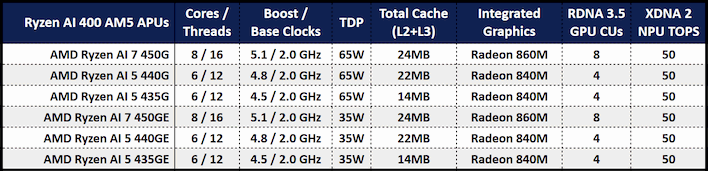
It doesn't take a genius to look at that and figure that it's a clearly inferior configuration versus the company's top previous-generation APU. The Ryzen 7 8700G features eight homogenous Zen 4 CPU cores clocked at up to 5.1 GHz, the same 65W TDP and 24MB total cache, and a 50% larger GPU with twelve RDNA 3 compute units. Given that, we expect the Ryzen AI 7 450G will be a bit behind the previous-gen chip in virtually all workloads—except, of course, for those that can make use of the 50 TOPS NPU.
That's necessary for systems so-equipped to acquire the all-important Microsoft Copilot+ branding, you see. The merits of such certification are actually dubious; Copilot+ PCs haven't exactly been flying off the shelves, and the backlash against Microsoft's aggressive AI push has been so strong that the company just publicly reaffirmed its commitment to improving reliability and performance in the base Windows 11 system.
Along with this launch, AMD is also releasing "PRO" versions of each of these processors; expect to pay a bit extra for the privilege of slightly improved security hardening and integrated remote management features, but otherwise, the PRO SKUs are exactly identical to the same "non-PRO" model. Likewise, AMD also announced the PRO versions of the mobile Gorgon Point processors today; they're so similar to the standard chips that the chipmaker didn't even provide a list of SKUs.
If enthusiasts like me are disappointed by the middling specifications of the new desktop APUs, then we're even more disappointed that AMD isn't selling these chips at retail like with Hawk Point. Instead, if you want a Ryzen AI 400 APU, you're going to have to buy a complete system from an OEM like HP or Lenovo, because these chips aren't coming in retail boxed form--at least not yet.





