



AMD Finally Caves To Memory Shortage With GPU Price Hikes


According to that post, AMD has finalized a plan to increase customer pricing for its graphics products. That doesn't mean pricing for you; AMD's customers are its board partners, like PowerColor, Sapphire, and XFX. The rumor states that the prices of GPU core and video RAM bundles, which the AIBs take and turn into completed graphics cards, are going up around 10%. That sounds pretty modest considering how expensive RAM is right now, but a 10% price increase for AIBs does not usually translate to a 10% price increase for end users.
Indeed, the post says AMD expects Radeon cards to return to roughly the same market positioning as comparable GeForce products. That's the way things normally are, but it's not the way things are right now. You can currently pick up a Radeon RX 9070 GRE card for $549, while the cheapest GeForce RTX 5070 card we see right now is $630. You can grab Radeon RX 9070 cards for $640, and the top-end Radeon RX 9070 XT is just $689, while NVIDIA's competing GeForce RTX 5070 Ti goes for $950 right now.
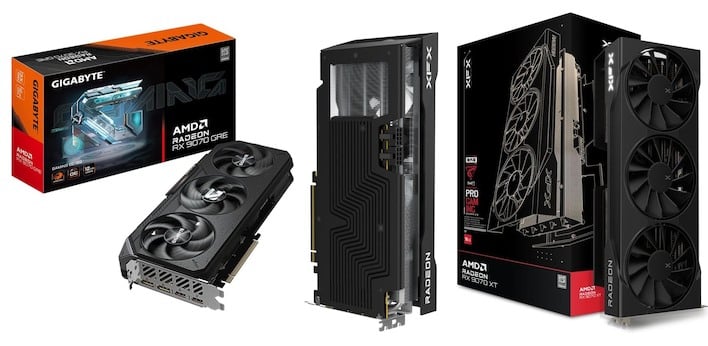
XFX Swift Radeon RX 9070 OC 16GB: $639.99 at Amazon
XFX Swift Radeon RX 9070 XT 16GB:
According to the report, AMD has actually been planning this since June, but chose to delay the price jump because there's still inventory in the channel that needs to move, and because end-user price sensitivity remains high (read: everyone is broke.) There was apparently also a concern that NVIDIA hadn't implemented its own latest round of price increases despite that GeForce cards have already been selling at historically high prices in most places.
It's easy to understand why chipmakers have retreated to B2B sales; selling pro gear to businesses offers higher margins and right now, because of the AI boom, there's virtually unlimited demand for nearly all kinds of chips. Still, these extremely high prices on most types of components are threatening to snuff out the DIY market altogether, and that's going to have serious aftershocks throughout all kinds of markets if it comes to pass. Hopefully the AI boom will recede (or go 'boom') and we see a return to a healthy DIY PC market despite the best efforts of platform holders who would prefer to capture everyone in cloud subscription rental schemes.
Thanks to 포시포시 for pointing out the WeChat post.





