



AMD Docs Confirm AM5 Upgrade Path To Zen 6 Olympic Ridge And Medusa1


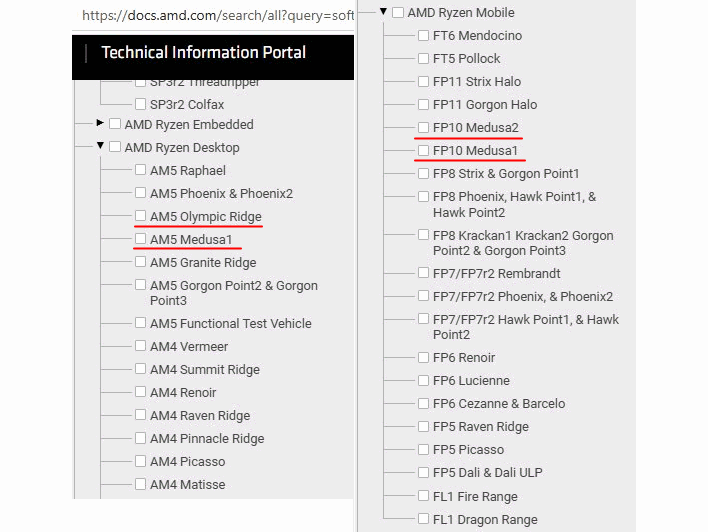
This information comes by way of known leak-spotter InstLatX64 on Xwitter, who pointed out the information on AMD's own website and managed to screenshot it before it was, seemingly, taken down. The page clearly listed "Olympic Ridge" and "Medusa1" for the AM5 socket, as well as the latter plus "Medusa2" for the FP10 socket. The inclusion of Medusa2 is interesting, as the latest rumors indicated that it had been cancelled.
So what are these codenames? Well, Olympic Ridge is the standard Zen 6 desktop family. By all accounts, they're shaping up to look a lot like the Zen 4 and Zen 5 desktop processors, with one or two Core Complex Dies (CCDs) attached to a chiplet I/O die (cIOD). The big differences this generation are that Zen 6 is reported to get a fully new I/O die with updated graphics, PCI Express, and USB connectivity, while the Zen 6 CCDs are known to sport four more cores and 50% more L3 cache, for a total of up to 24 cores and 96MB of L3 on the top-end (ignoring 3D V-Cache variants.)
We already knew Olympic Ridge would drop into existing Socket AM5 motherboards, both because AMD said so and also because motherboard vendors unsubtly promised as much with BIOS updates already adding support for "next generation AMD processors." We had less confirmation about Medusa, also known as Medusa Point, which is expected to be AMD's main family of mobile processors for Zen 6.

Somewhat similar to Strix/Gorgon Point (the Ryzen AI 300/400 processors), these parts include a mix of "Classic" and "Dense" cores as well as more powerful integrated graphics than Olympic Ridge's basic display adapter (or potentially, AI NPUs.). However, rumors this time around claim that Medusa is actually a modular architecture with the ability to be packaged with a full-fat Zen 6 CCD, adding up to 12 classic cores. According to leaksman Tom at Moore's Law is Dead, this CCD is optional on the FP10 platform, implying that it may be standard on the Socket AM5 platform.
It's not completely clear why AMD would want Medusa processors on Socket AM5 to have the extra twelve cores. The base Medusa Point die is said to have four Zen 6 cores, four Zen 6C cores, and two Zen 6 LP cores, giving it ten CPU cores; already quite a potent configuration. It's easy to imagine that anyone wanting the full 22 cores would likely purchase a 20 or 24-core Olympic Ridge part, which will have better single- and multi-core performance, better I/O, and a fully homogenous configuration. We'll have to see if these rumors turn out to be true.





