



AMD Folds Anti-Lag 2 Into FSR With New Latency Reduction Label


At least, one other AMD technology is: AMD Anti-Lag 2, which is apparently being renamed in real time to "FSR Latency Reduction 2.0". The rename hasn't been announced by AMD; rather, Whycry over at Videocardz dug into the AMD FSR SDK source and found a commit that seems to change the name of the technology in that software package. The FSR SDK is used by developers to integrate FSR technologies into their games and apps.
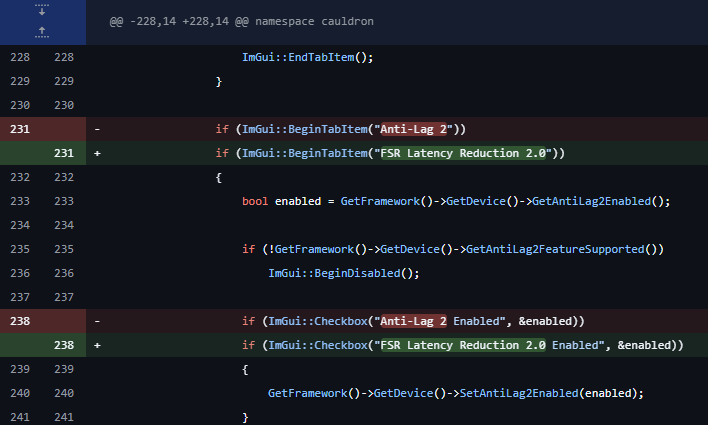
Source: AMD FSR SDK commit e236f23
Commit e236f23
The name change is kind of hilarious for a few reasons. On the one hand, it makes complete sense; AMD's Anti-Lag feature hasn't been talked about much, and the press that it has gotten has largely been negative, such as when the initial driver-based version of it got CS2 players banned for cheating. Now, Anti-Lag 2—oh, sorry, "FSR Latency Reduction 2.0"—requires game-specific integration, same as NVIDIA's Reflex, so there's no real risk of it getting players banned, but it's also simply not available in many games. AMD lists nine titles on its website: Call of Duty Black Ops 6 and Warzone, Valve's Counter-Strike 2, Deadlock, and Dota 2, Ghost of Tsushima, Horizon Zero Dawn, MechWarrior 5, and Naraka: Bladepoint.
But on the other hand, the name isn't even consistent with AMD's own naming scheme. FidelityFX Super Resolution 4, a name that was useful because it conveyed information to the user (i.e. which version of FSR upscaling you were using) has now been collapsed into the vague "FSR Upscaling" label, denied its useful number. But we're still going to call Anti-Lag 2 "FSR Latency Reduction 2.0", huh?
In AMD's defense, the company hasn't officially shipped this name, so there's time to change it. For all we know this could be one cheeky developer making a temporary change that nobody was supposed to notice. That's probably not the case, though; AMD (like most tech companies) has a long history of incomprehensible product naming decisions, and we expect this one is similar to the rest. Hopefully the name change means that AMD is bringing the lag-reduction tech to more titles soon.





