



A Runaway Supermassive Black Hole Is Ripping Through Space At 2.2 Million MPH


Scientists first detected the phenomenon through JWST’s Near-Infrared Spectrograph (NIRSpec) instrument. Well, technically Hubble spotted the mysterious streak of gas a while ago, but JWST allowed astronomers led by Pieter van Dokkum to take a closer gander at the tip of that trail. There, they found the smoking gun: a supersonic bow shock where the black hole is plowing into intergalactic gas like a cosmic snowplow.
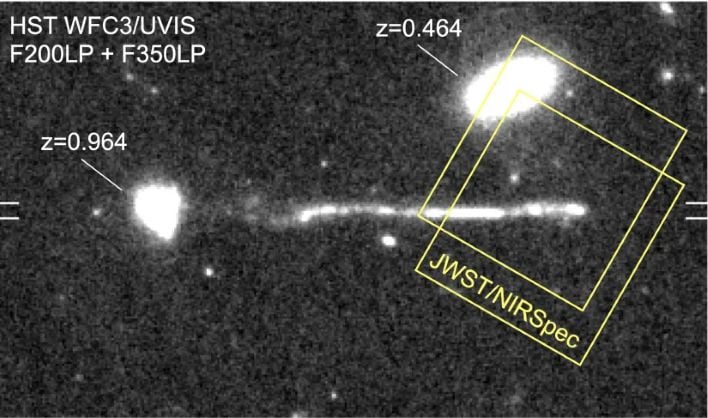
Such is the speed of the black hole in question is that it could transit from the Earth to the moon in 14 minutes. As it tears through space, it leaves behind a wake of compressed gas that triggers the birth of new stars, creating a 200,000-light-year-long stellar tail that traces its path back to its original host galaxy. This tail is nearly twice as wide as our entire Milky Way.
Officially designated RBH-1, the rogue object validates the decades-old slingshot theory. It suggests that the universe may be populated by more of these invisible, wandering giants than previously thought. No doubt, scientists will continue to use JWST as well as other tools like the upcoming Nancy Grace Roman Telescope, to hunt for signs of similar runaway black holes like RBH-1. Perhaps in studying how these black holes are ejected and the star
formation they trigger in their wake, we can better understand
the forces that have shaped the large-scale structure of the cosmos over
billions of years.
Main photo credit: NASA, ESA, Leah Hustak (STScI)





