



$4,000 Audio Cable Versus $7 Amazon Basics Test Reveals What You Suspected


A recent blind test confirms that the only thing a $4,000 boutique audio cable transmits more effectively than a $7 Amazon Basics cord is a massive amount of cash from your bank account to the manufacturer’s pockets. The guilty party in this case is Kimber Kable, although brands like Monster and Audio Quest have been on the naughty list as well.
Due to its mostly subjective aspect, the high-end audio business has long been a haven for snake oil salesmen who promise that silver-plated conductors and diamond-coated dies can somehow make a jazz piano sound three-dimensional. However, a scientific teardown by Amir Majidimehr of Audio Science Review has, once again, put the kibosh on the matter. Pitting a $4,250 Kimber Kable Select KS-1136 against a cheap-o Amazon Basics RCA cable ($7.19), the analysis looked for differences in frequency response, noise, and distortion.
The results were a catastrophic embarrassment for the luxury brand whereby the test equipment found that the two cables performed almost identically. In fact, the $4,000 cable actually showed slightly more mains power noise than its $7 rival. Across every meaningful metric, such as phase difference, square wave response, and frequency range, the two cables were twins. The only measurable difference was a microscopic increase in jitter on the Amazon cable, which Majidimehr noted was likely just because the Amazon cable was longer.
The boutique Kimber cable is marketed with the kind of vocabulary usually reserved for rare space minerals, while in contrast, the Amazon cable is marketed simply as a thing that plugs into your TV. Yet, the physics of audio transmission is proven to be pretty much the same regardless of marketing mumbo-jumbo. As the study pointed out, an RCA cable is essentially a 100-lane highway for an audio signal that only needs one lane. Upgrading the cable is like paving that 100-lane highway with gold; it doesn't matter how shiny the road is if the traffic is already moving at full speed.
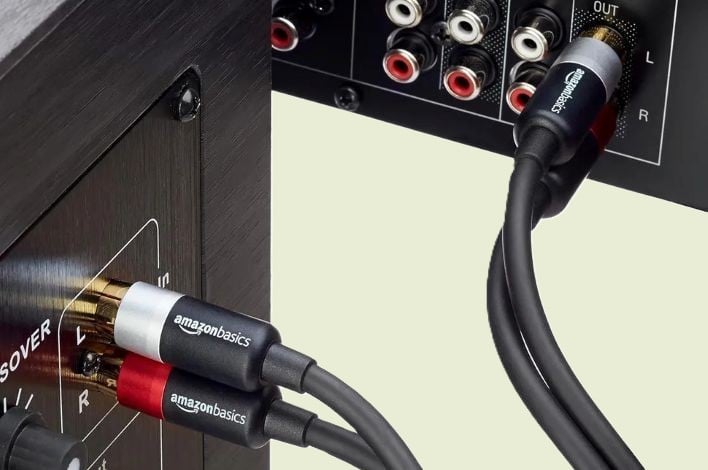
Moreover, the Kimber cable even managed to be worse in terms of basic ergonomics. It features a specialized locking mechanism that, if forgotten, could actually cause a user to rip the internal components out of their amplifier while trying to unplug it. Furthermore, the interior of the luxury connector was found to contain "flimsy plastic tabs" that seemed lower in quality than the Amazon cable.
While some audiophiles claim that with an ultra-expensive cable, they can hear the extra air or hear the spittle splashing out of Louis B. Armstrong's saxophone, good old A/B testing proves that what they're mostly feeling is a placebo effect. For anyone looking to improve their home theater, the data is clear: buy the $7 cable and spend the remaining $3,993 on literally anything else.





