


Items tagged with astronomy

As we get ready to close out the year, the Leonid meteor shower is going to reach its peak tomorrow morning, November 18th. While the shower might end up being a bit of a quieter one, there is still the opportunity to see a handful of...
Read more...

The Taurid meteor shower kicks off the month of November for skywatchers. At its peak, the Taurid meteor shower is expected to showcase about ten meteors per hour, with the Leonids meteor shower following shortly after with an estimated...
Read more...

In true Halloween fashion, a comet twice the size of Mount Everest and that earned the nickname the “Devil Comet” is heading toward Earth. The comet, which has a far less intimidating scientific name, Comet 12P/Pons-Brooks, has a...
Read more...

Jupiter will accompany this weekend's Hunter's Moon as the duo parade across the night sky together. The Hunter's Moon gets its name from the Algonquin Native American tribe and was used to remind native American cultures that it was time...
Read more...

A global team of astronomers detected an eight-billion-year-old fast radio burst (FRB) that is the most ancient to date. The record-breaking FRB destroyed the old record by 50 percent.
FRBs are extraordinary events that generate as much...
Read more...

A new study reports two ice giant exoplanets colliding near a sun-like star, creating an astonishing afterglow in deep space. Astronomers were able to view the afterglow of light and plumes of dust as it passed in front of the parent star...
Read more...

Astronomers are slamming a massive low-Earth orbit communications satellite because it is brighter in the night sky than most stars. Astronomers are concerned that without some type of regulation on these extremely bright satellites, the...
Read more...

Later this week, sky watchers will be privy to the last supermoon of 2023 and its being a Harvest Moon. The Harvest Moon will be accompanied by two planets shining brightly in the night sky, Saturn and Jupiter.
A Harvest Moon denotes...
Read more...

The Moon will be at its brightest and fullest as it passes by the ringed planet Saturn in the night sky this week. This is the second full Moon of August, making it the year's only Super Blue Moon.
Saturn comes to opposition of Earth's...
Read more...

The second full Moon of August will be a Supermoon as well as a Blue Moon all wrapped into one. Along with the incredible Supermoon, Saturn will be its closest and brightest for the year.
The second full moon in a single month is...
Read more...

A team of astronomers shared new images captured by NASA's James Webb Space Telescope (JWST) of the iconic Ring Nebula known as Messier 57 (M57). The awe-inspiring images highlight the nebula's labyrinthine allure in astonishing detail...
Read more...

An international team of astronomers has discovered a new type of stellar object that challenges how the physics of neutron stars are understood. The deep space object that has them questioning themselves is an extremely rare type of star...
Read more...

A Jupiter-like planet has escaped what should have been certain death at the hands of its sun. Exoplanet 8 UMi b, named Halla, which closely orbits its host star Baekdu, survived a period of murderous stellar transition that would have...
Read more...

Stargazers will be able to view a rare alignment of five planets in the night sky Saturday morning. Mercury, Uranus, Jupiter, Neptune, and Saturn will all be visible just before sunrise.
While planets aligning in the starry night sky...
Read more...

An international team of astronomers has discovered the second-ever multiplanetary circumbinary system, giving Star Wars fans more hope that one day they might be able to travel to a Tatooine-like planet. The newly found planet, BEBOP-1c...
Read more...

Heads up! On March 28th, five planets will be putting on a rare celestial show in a parade of planets, with guest appearances by the moon and start cluster Messier 35.
Tuesday March 28th will see Jupiter, Mercury, Mars, Uranus, and...
Read more...

A new study proposes how Earth's evil twin, Venus, may have once been habitable for a brief amount of time in its past. Researchers suggest that Venus has more than likely been uninhabitable for over 70% of its history, which is four times...
Read more...

Astronomers using the Very Large Telescope (VLT) in Chile discovered a Jupiter-like exoplanet in the AF Leporis system. The system is said to be similar to our own Solar System, with a star roughly the same mass, size, and temperatures as...
Read more...
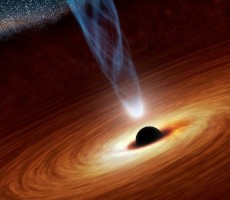
A group of scientists have proposed evidence that black holes are what produce dark energy. The new work potentially means nothing needs to be added to what we already know about the Universe to account for dark energy, in that black holes...
Read more...
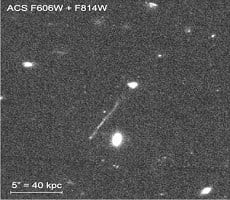
Astronomers spotted an unexpected trail in the gas surrounding a dwarf galaxy while using the Hubble Space Telescope. During the team's observations, a trail of an ejected supermassive black hole is believed to have been detected. The...
Read more...

A team of astronomers has discovered a rare Earth-mass exoplanet orbiting in the habitable zone of a star. Exoplanet Wolf 1069 b and the star it orbits, Wolf 1069, are located approximately 31 light-years from Earth.
Finding an...
Read more...

A Northwestern University astrophysicist has produced a stunning video of four planets dancing around their sun. The tantalizing planetary dance was made using observations over a 12-year period.
The four exoplanets tripping the light...
Read more...