



Wild Hardware Hack Brings Doom To A Vintage Canon DSLR Camera


To contextualize a bit, the Canon EOS 550D was released on February 24th, 2010. It obviously wasn't intended for any kind of gaming, but its compatibility with the Magic Lantern firmware opens the gates for possibilities like this. Magic Lantern isn't a Canon project, but rather an open-source firmware for certain Canon EOS cameras that unlocks additional features and capabilities, nerfed by Canon's own firmware for these older bodies.
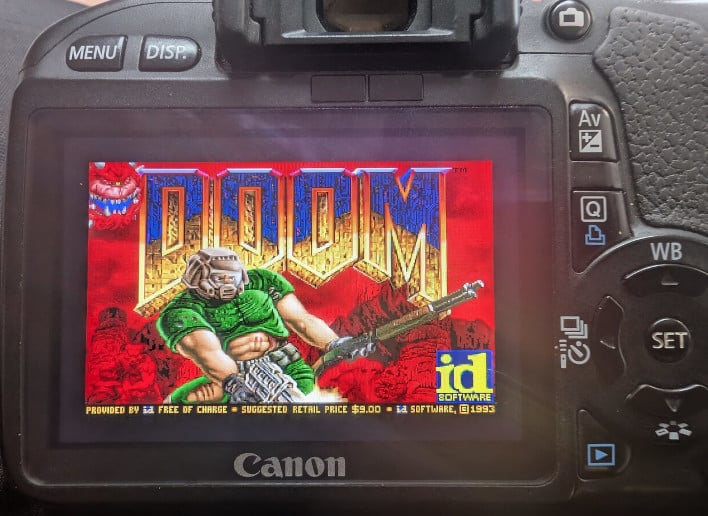
Doom550D is a full, functioning port based on the FreeDoom release. Because it's built atop FreeDoom, Doom550D enables users to play Doom, Doom II, The Ultimate Doom, and a number of popular expansions including The Plutonia Experiment. The port even includes an "extra unofficial fullscreen" option that renders gameplay at 360x240, forming a perfect integer scale for the camera's native 720x480 display. The downside is that the "extra unofficial fullscreen" option also hides the status bar, which can be troublesome if you want to monitor your health and ammo values.
What stands out most about this port is how little technical limitations seemed to impact the project. Compared to the compromises in projects like Nintendo Alarmo Doom and especially Commodore 64 Doom, the Doom gameplay experience on the Canon 550D seems pretty much intact. The computational hardware used for DSLR cameras of this vintage clearly outstripped Doom's basic requirements a long time ago.
Most importantly, it actually looks like it would be fun to play. While right-handed movement controls and pressing "Set" to fire will likely require some adjustment, a Canon EOS 550D is still ergonomic enough for such controls to be usable.




