



Sony's Table Tennis Robot Ace Defeats Top Human Players


Earlier this week, robots were seen running faster than us, and now a Sony-developed autonomous robot has shown its mettle by defeating high-ranking human athletes in the high-speed, unpredictable environment of table tennis. In this case, the achievement marks a breakthrough in physical robotics, requiring the machine to master complex motor skills, split-second decision-making, and real-time adaptation to human psychology and dynamic ball play. How far we've come from Aibo.

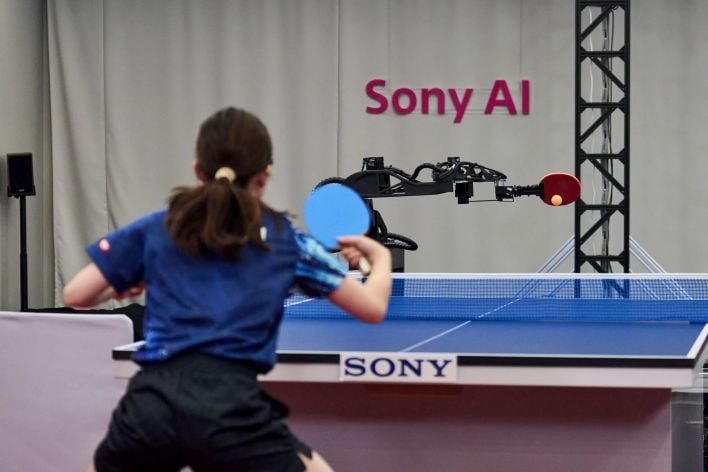
Published in the Nature journal, the research describes a robot arm equipped with a paddle and a high-speed vision/motor system capable of tracking a ball at sub-millisecond speeds. In a series of competitive matches against players ranging from intermediate to elite levels, Sony's Ace robot won most of matches against Elite-level players (three female and two male), while putting up tight fights in all sets against two professional players.
The system utilizes a hierarchical AI architecture, where a high-level controller selects the best strategy, such as whether to play defensively or aggressively, while low-level controllers manage the precise physics of the swing.
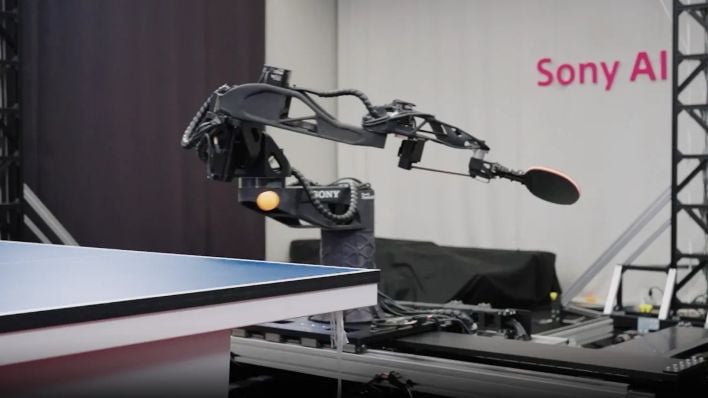
One of the most significant challenges in table tennis is the "spin" applied to the ball, which causes it to curve in mid-air or bounce at erratic angles. To learn this, the engineers trained the robot using a combination of massive simulations and real-world reinforcement learning, letting it play millions of virtual matches to understand the physics of aerodynamics before ever stepping onto a physical court.
During the matches, the researchers (and players, no doubt) noted that the robot did not just rely on speed, but on tactical placement. It frequently targeted the crossover point (the area near a player's hip where they must decide between a forehand or backhand stroke) to force errors. While humans still hold a slight edge in raw creativity and the ability to adapt to completely new playstyles mid-match, the gap is narrowing. Unlike human players who suffer from fatigue or emotional pressure, the robot maintained a consistent level of precision throughout several hours of play.
Sony has showed that a robot like Ace can have immediate applications in warehouse automation, emergency response, and domestic assistance. It also proves that AI can now bridge the gap between robotics and physical dexterity, handling tasks that require a delicate touch and lightning-fast reactions.
Likewise, within the sport, Ace might be able to teach human players a new trick or two previously thought impossible. Upon seeing shots played by the robot, one of its opponents, Kinjiro Nakamura, table tennis expert and 1992 Olympian, said “no one else would have been able to do that. I didn’t think it was possible. But the fact that it was possible ... means that there is a possibility that a human could do it too.”





