



Razer Forges Into AI Hardware Market With A Monster Workstation Packing Up To 4 GPUs


If you had Razer entering the AI workstation market on your 2026 Bingo card, then you're off to a stellar start. Razer, best known for its gaming peripherals, announced the Forge AI Dev Workstation at CES, and it packs some serious horsepower to achieve the "next AI breakthrough," or so goes part the marketing pitch. Razer backs up its claim with support for up to four NVIDIA RTX Pro 6000 Blackwell or AMD Radeon Pro GPUs to accelerate large-scale model training times.
"The Forge AI Dev Workstation fulfills Razer’s vision for powerful, purpose-built AI hardware, delivering end-to-end local performance with secure on-device compute, zero subscription costs, and maximum responsiveness," Razer says.
Outside of the GPU(s), the Forge AI Dev Workstation harnesses either AMD Ryzen Threadripper Pro or Intel Xeon W processors. It's also equipped with eight high-speed DDR5 RDIMM slots to install gobs of RAM, and for storage, it supports up to four PCIe Gen5 M.2 NVMe solid state drives (SSDs) and also boasts eight SATA bays.
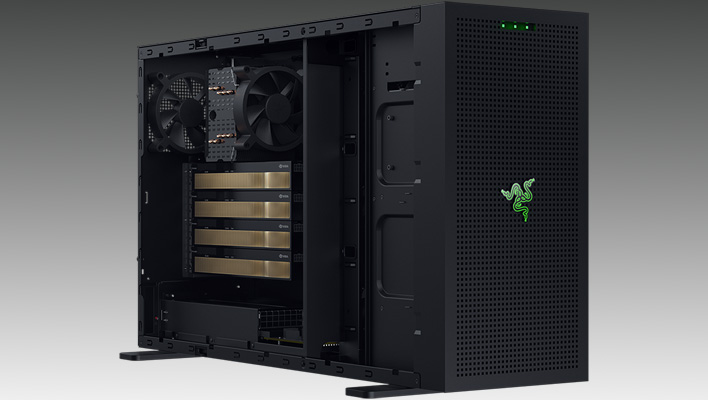
Other features include dual 10-Gigabit Ethernet ports for fast network access, a 2,000W power supply, and a rack-ready design to seamlessly scale from from a single-tower setup.
"When your workload outgrows a single tower, the same system transitions into rack environments. The chassis is engineered with rack-mount compatibility, cable-management pathways, and front-to-back airflow to support dense cluster configurations," Razer says.
In conjunction with its new workstation, Razer's also pitching its AIKit, an open-source AI development toolkit supporting all NVIDIA GPUs (including consumer, data center, and Jetson variants).
The Razer AIKit is built on vLLM Ray and makes use of LlamaFactory. Razer says it suppots any vLLM-compatible model from Hugging Face Hub, with over 280,000 LLMs available to run locally. And while purportedly optimized for the Forge AI Dev Workstation, Razer says AIKit is not limited to its own hardware and will run on any system with a compatible GPU.
Anyone interested in Razer's new hardware can head to the Forge AI Dev Workstation page and fill out a form for a customized quote.




