



Qualcomm Lands Meta As Major Launch Partner For Its New Dragonfly AI Chips


The pitch centers on agentic AI, the always-on software assistants that reason continuously rather than answering one prompt and going quiet. That style of computing chews through far more inference work, and Cristiano Amon, president and CEO of Qualcomm Incorporated, argued that "infrastructure has to deliver much higher performance at lower power and cost" to keep pace. Qualcomm thinks efficiency is exactly where it wins. The roadmap also arrives alongside the company's $3.9 billion purchase of AI software startup Modular, a signal that Qualcomm wants the developer layer too, not just the raw silicon.
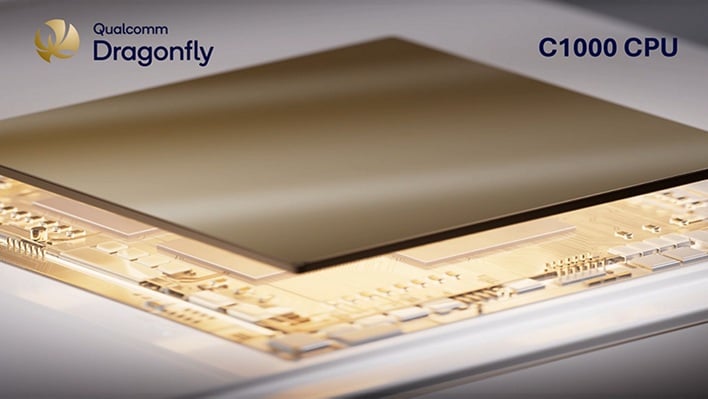
Three pieces anchor the plan. First comes the Dragonfly C1000 CPU, a data center processor running custom Oryon cores past 5GHz, with a chiplet design packing more than 250 cores. Qualcomm pairs it with greater than 2TB/s of PCIe Gen 7 connectivity plus CXL support, and it estimates better than twice the performance per watt of competing server processors. Commercial availability lands in 2028, with both air and liquid cooling on the menu.
Second is High Bandwidth Compute (HBC), Qualcomm's answer to the memory wall that strangles generative AI. Rather than leaning on conventional High Bandwidth Memory (HBM), it stacks compute and memory together in 3D silicon. The first generation ships with the AI250 accelerator and targets 133TB/s per card, which Qualcomm frames as an 18x jump over its LPDDR5X-based AI200. A second generation aims for a 54x leap over that same AI200. Sampling for the first generation arrives in mid-2027.
Third, the Dragonfly AI300 folds in that second-gen memory tech and goes after large language and multimodal models directly. Qualcomm projects a four-to-eight times performance-per-watt gain over current GPU-based setups, measured on memory bandwidth per watt per card. It scales up using UALink and ESUN, then scales out across copper and optical links. Sampling begins in 2028.
The Meta agreement is the headline grabber, arriving weeks after a reported deal to supply custom AI chips to ByteDance and handing Qualcomm two marquee customers in quick succession. Qualcomm silicon already turns up across Meta's hardware, from the new $299 Meta Glasses to, soon, its server fleet. The fine print still matters. Meta committed to the C1000 CPU specifically, with that chip slated to power its next-generation servers, so this is a processor win first and an AI accelerator story second. Beyond those names, Qualcomm says more than 35 partners back the roadmap, including Supermicro, Lenovo, Arista, Micron, Samsung SDS, and SK hynix.
None of this dethrones anyone overnight, and most of the hardware sits two years out. Still, a credible third name elbowing into a market run by a familiar handful is good news for anyone who buys, or ultimately pays for, AI compute. In Qualcomm's press release, it stated it was committed to an annual release cadence, which signals it plans to stick around for the long haul.





