



NVIDIA Upgrades RTX Pro 5000 Blackwell GPU With Monstrous 72GB VRAM


It's usually gamers who are the most vocal about more more VRAM on their graphics cards, but it's especially beneficial in the workstation and server space as the industry puts a bigger emphasis on machine learning (ML) and artificial intelligence (AI) workloads. As such, NVIDIA is now offering an upgraded version of its RTX Pro 5000 Blackwell accelerator with a whopping 72GB of GDDR7.
That's a generous 50% increase in VRAM capacity compared to the original release's 48GB. Both are of the GDDR7 type with error correcting code (ECC). Other specifications remain the same, meaning the RTX Pro 5000 Blackwell features a 512-bit memory bus on both variants, resulting in 1,344GB/s of memory bandwidth.
For context, NVIDIA's flagship GPU for gaming, the GeForce RTX 5090, mates 32GB of GDDR7 (28Gbps) to a 512-bit bus for 1,792GB/s of memory bandwidth. That's right gamers, your top-end GPU actually delivers more memory bandwidth than the RTX Pro 5000 Blackwell, according to NVIDIA's listed specifications.
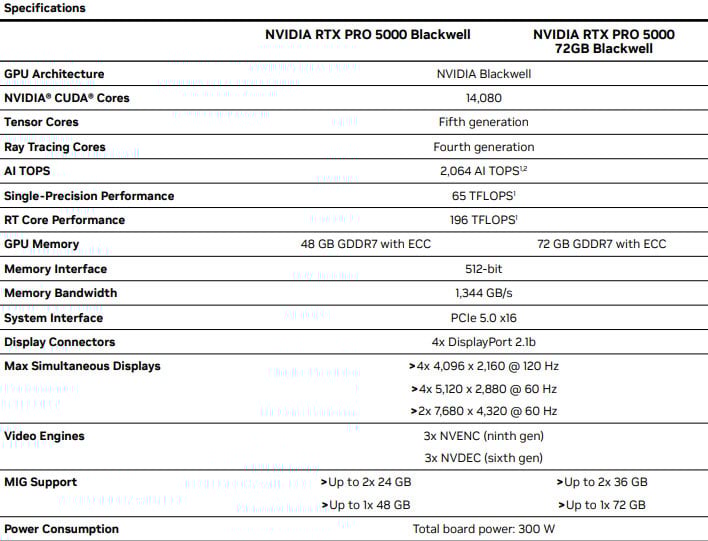
To arrive at 1,344GB/s of memory bandwidth on a 512-bit bus width, NVIDIA would need to be using 21Gbps GDDR7 memory chips on its RTX Pro 5000 Blackwell GPUs, versus faster 28Gbps chips on the GeForce RTX 5090.
The GeForce RTX 5090 also sports more CUDA cores at 21,760 versus 14,080 on both RTX Pro 5000 Blackwell variants.
Of course, comparing a workstation part with ECC memory to a gaming card with faster chips is not exactly apples to apples. For those who need even more VRAM and more bandwidth in a workstation setting, the RTX Pro 6000 Blackwell remains the top part, with 96GB of GDDR7 (with ECC) tied to a 512-bit bus, for 1,792GB/s of memory bandwidth. It also features 24,064 CUDA cores.
"Unlock next-level AI performance and neural rendering capabilities with NVIDIA RTX Pro 5000 Blackwell GPUs. Built on the NVIDIA Blackwell architecture and equipped
with 48GB or 72GB of ultra-fast GDDR7 memory, it accelerates everything from AI
development, large language model (LLM) inference, and generative AI workflows,
along with high-fidelity simulations, video production, and complex 3D modeling
from your desktop," NVIDIA says.
This was a quiet upgrade on NVIDIA's part with no mention of pricing or availability, just an updated product page. That said, the RTX Pro 5000 with 48GB of VRAM typically sells for around $4,100 and up, based on listings we've seen, so expect the 72GB model be somewhere north of that figure, and south of $9,100, which is about where pricing starts for the RTX Pro 6000 Blackwell (Max-Q model).




