



Noctua Details Why Black PC Fans Take Years of Engineering


Have you ever likened the process of engineering a PC cooling fan as being akin to baking a complex soufflé? Noctua has, and the analogy sheds details on why it takes the company so much longer to release a fan in the black colorway after releasing the same model in classic colors, especially the brown and beige combination that Noctua is known for (like the ones on the Noctua Superdome fan project)
"People often wonder why the chromax.black versions of our fans take longer to launch after the classic colors. In a nutshell, the reason is that this is less like painting a wooden fence, which is easy, and more like changing the color of a carbon-fibre Formula 1 part, which requires re-calculating the weight, strength and aerodynamics," Noctua says.
The blog post outlining the complexity of changing colors is a rare, behind-the-scenes look at how the sausage is made, so to speak. And what it boils down to is the process of injection molding, which entails melting plastic and jamming it into a steel mold so it can cool and harden into the desired shape, a processor otherwise known as tooling.
For high precision engineering, this is where the soufflé analogy comes into play, which is far more complex than making ice cubes. Why is that? To make ice at home, all you need to do is pour water into a tray, stick it in the freezer, and wait. But for a soufflé to come out right, "every degree of temperature and milligram of ingredients matters." Same goes for fans.
"The flow rate, cooling time, and pressure must be perfectly balanced to ensure the plastic crystallises, cools correctly, and holds its structural integrity and dimensional precision. When you introduce a new variable, like coloring pigments, that delicate balance is disrupted," Noctua explains.
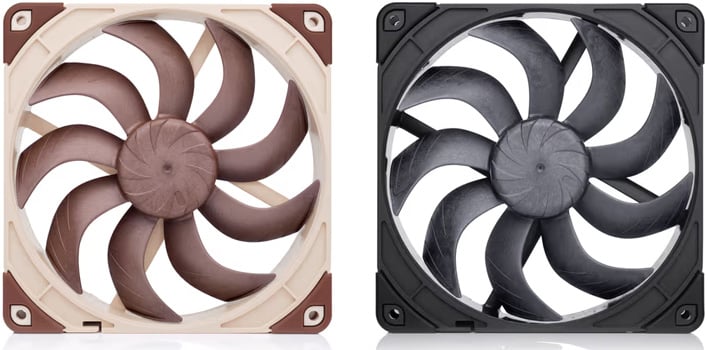
Noctua also points out that when dealing with high-precision fans with small tip clearances, minor process variations and material-related factors, make the process more complex to achieve the desired result. If a tolerance is off even by just a few tenths of a millimeter, it can pose a problem.
"Color pigments impact the injection molding of these high-precision fans because the pigment particles behave like tiny solid fillers inside the melt. Their size, surface area, and thermal behavior directly influence how the polymer flows into the mold, as well as how it cools and solidifies," Noctua says.
Noctua goes on to state that black pigments behave very differently from beige or brown metal-oxide pigments found in the company's standard fans. That's because carbon black particles are much smaller with a significantly higher surface area, and alter the melt viscosity, heat absorption, and crystallization behavior.
The blog post goes into even more detail and is definitely worth a read, especially if you're a *ahem* fan of Noctua and its fans. Even if you're not, it's a worth a read, as it's not too often that companies pull the curtain back to give outsides a look inside.
Related, Noctua says it is nearing the release of the chromax.black version of its NF-A12x25 G2 fan, which originally released 10 months ago in beige and brown.




