



Breakthrough Memory Chip Can Withstand Extreme Heat Hotter Than Molten Lava


Typically, standard silicon chips begin to fail around 200°C. To solve this physical limitation, the USC team, led by Professor Joshua Yang, engineered a nanoscale sandwich using materials chosen for their extreme durability.
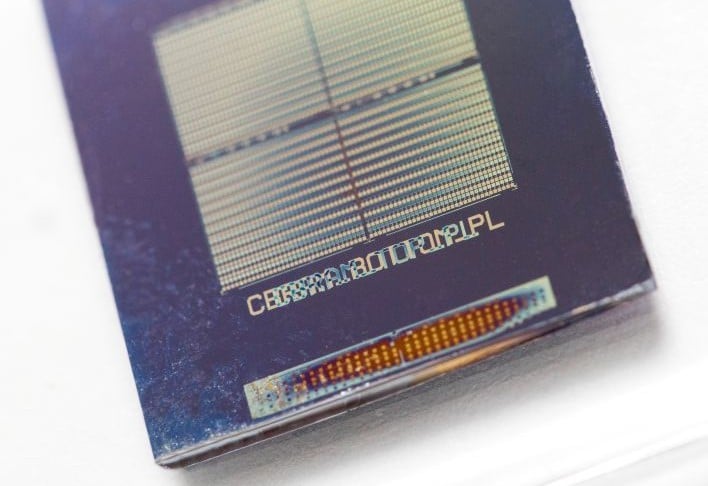
The team's development resulted in a memristor, a nano-component that can both store data and perform logic operations. In this instance, the memristor features a top electrode made of tungsten (which has the highest melting point on the periodic table) and a bottom electrode made of single-atom-thick sheet of graphene. Sandwiched between them is a thin layer of hafnium oxide ceramic. This specific combination has been the secret to the chip's resilience. The USC researchers discovered that tungsten and graphene share a unique surface chemistry; the tungsten atoms are unable to anchor onto the graphene sheet, preventing the migration (i.e. short circuiting) that typically ruins chips at high temperatures.
During testing, the device held data for over 50 hours at 700°C without requiring a refresh and survived more than a billion switching cycles. In fact, the team noted that 700°C was not necessarily the limit of the chip, but rather the maximum temperature their testing equipment could safely reach.
Then there's the implications of local and space exploration. Current landers sent to the surface of Venus, where temperatures hover around 460°C, survive less than half an hour before their electronics fry. This new chip could enable longer-term robotic missions, as well as more efficient deep-earth drilling for geothermal energy and improved monitoring systems inside nuclear reactors.
Main photo credit: University of Michigan





