



NASA's New Roman Telescope Nears Launch With Billions Of Galaxies In Sight


NASA is deploying another high-end telescope to peer into the far reaches of space, and after two decades of development, a launch is now only weeks away. After passing a series of tests, NASA's Nancy Grace Roman Space Telescope, as it's called, made its way to the agency's Kennedy Space Center in Florida to begin final prelaunch preparations for a summer launch.
A telescope of this magnitude is not something you can just load in the back of a pickup truck and haul down the road. It weighs nearly 18,000 pounds (8,200 kilograms) and booked a trip on NASA's Pegasus barge to make its way down the coast of the Atlantic Ocean en route to its forever home in Florida.
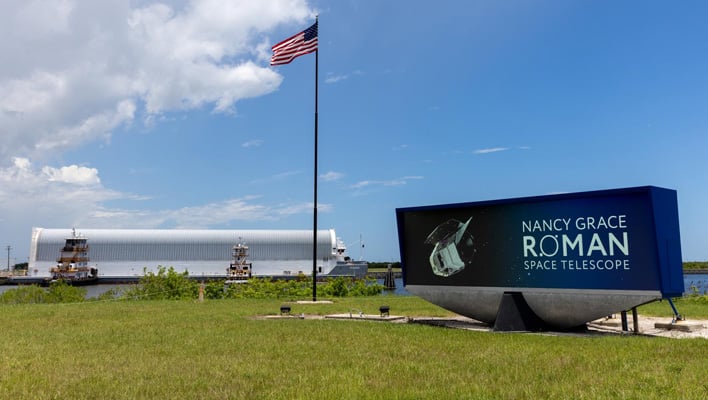
The next step is to perform extensive cleaning to remove the bulk of contaminants introduced during transport, after which it will be brought inside NASA's facility for a full and proper unboxing. From there, the Roman telescope will make its way into a clean room, and then large cranes will hoist it onto its work platform, called the Pantheon. for further inspections.
If everything goes to plan, Roman will liftoff in late summer on a SpaceX Falcon Heavy rocket fro Launch Complex 39A at Kennedy. NASA says it is targeting no earlier than August 30, which would put liftoff eight months ahead of schedule.
"After launch, Roman will travel to the second Sun-Earth Lagrange point, or L2. There, it will make observations that give astronomers the chance to study an incredible number of new objects. Roman’s wide field of view and rapid survey capabilities will reveal billions of galaxies, hundreds of thousands of new exoplanets, hundreds of blackholes, and will provide vast volumes of daily data for astronomers to study," NASA says.
Roman will also be tasked with mapping how common different kinds of planets are in our galaxy in hopes of answering "big questions about the universe." Those questions include finding the cause of the universe's rapid expansion and what cosmic objects look like in infrared light, among other queries.
Compared to the James Webb Space Telescope (JWST), which can see further back in time with higher resolution images, Roman is capable of capturing images 50 time larger for more panoramic views. Roman will enable astronomers more efficiently explore space even when they do not have a specific target.
"Since it will see such a large area of the universe at any given time, Roman will discover uncommon events that space telescopes have historically only been able to observe after ground-based telescopes have identified them. The mission will spot phenomena such as colliding neutron stars that Webb will likely never detect on its own with its narrow view," NASA explains.
Put another way, Roman will not replace JWST (or Hubble, for that matter), but supplement it after it launches this summer or fall.




