



MSI Pro Max Edge AI+ Mini PC Runs 120B Local AI Models With 128GB RAM


As demand for local, privacy-focused artificial intelligence continues to surge, enterprise developers and researchers are searching for hardware capable of running heavy Large Language Models (LLMs) without relying on potentially costly cloud APIs or power-hungry server racks. Enter MSI's new Pro Max Edge AI+, a mini PC that offers an alternative to the cloud.
The mini PC is built for on-device AI inference with gobs of memory and high-end hardware housed in an ultra-compact, 4-liter aluminum chassis. It has the ability to run massive LLMs with up to 120 billion parameters entirely offline.
Specs vary, but the Pro Max Edge AI+ is available with up to an AMD Ryzen AI Max+ 395 (same as found in AMD's Ryzen AI Halo), a powerful Strix Halo chip based on Zen 5 featuring 16 cores, 32 threads, 3GHz (base) to 5.1GHz (max boost) clock speeds, 16MB L2 + 64MB L3 for 80MB of total cache, onboard Radeon 8060S graphics with 40 cores clocked at up to 2.9GHz, and an onboard NPU capable of up to 50 TOPS. The chip as a whole is rated to deliver up to 126 TOPS of AI muscle.
It's the memory that is the real secret sauce here behind the mini PC's stout LLM chops. It can be equipped with up to 128GB of fast LPDDR5X-8000 unified memory. Tapping into AMD's Variable Graphics Memory technology, up to 96GB of that memory pool can be allocated as VRAM.
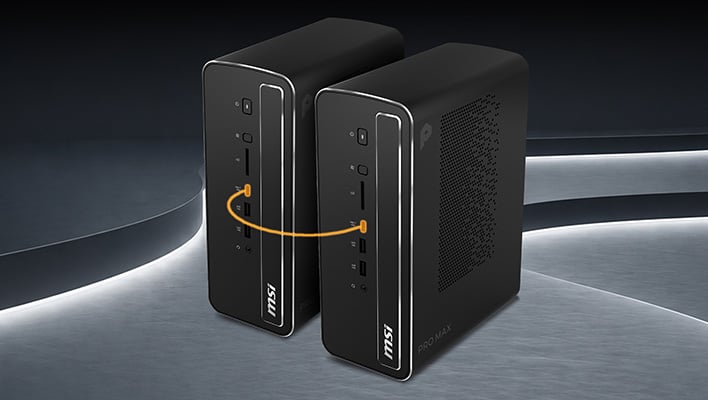
The unified memory aspect helps sidestep traditional hardware bottlenecks that might otherwise force buyers toward costlier workstation GPUs, enabling MSI's mini PC to churn out roughly 15 tokens per second on a 109B parameter model. And for research teams handling massive datasets, multiple units can even be strung together to run open-source models scaling up to a whopping 670 billion parameters.
What about cooling?
"To ensure reliable operation during extended AI inference sessions, the system features MSI Frozr AI Pro Cooling and MSI Glacier Armor, an advanced thermal solution engineered to maximize cooling efficiency and maintain long-term system stability under sustained workloads," MSI explains.
Lots of connectivity is on tap too, including Wi-Fi 7 and Bluetooth 5.4 for wireless chores, and a host of USB ports and other I/O options.
MSI did not mention a price or release date for its new Pro Max Edge AI+.




