



LG’s FLiPP Tech Could Finally Solve OLED Burn-In And Dim Screens


Essentially, FLiPP bypasses the traditional fine metal mask (FMM) construction whereby a stencil-like process in which red, green, and blue organic materials are evaporated through tiny physical apertures in metal sheets. Conventional FMM production suffers from significant mechanical limitations: mainly, physical metal masks tend to sag under their own weight when scaled to larger dimensions, causing alignment errors, color mixing defects, and severe panel size constraints. Furthermore, whenever a manufacturer alters panel dimensions or resolution, expensive new custom metal masks must be fabricated, driving up expenditure and reducing operational flexibility.
What FLiPP does is replaces said masks with precision photolithography via ultraviolet light etching to sequentially deposit and lock RGB subpixels into exact positions. By removing the dead space previously required to hold metal masks in place, FLiPP expands the display's aperture ratio (i.e. the area actively emitting light) by approximately 55%. Under testing conditions against FMM panels, FLiPP displays achieve a 1.6x boost in peak brightness, a 2.4x extension in operational lifespan, and 13% lower power consumption. Because light escapes more efficiently across a broader subpixel area, the display generates less heat during operation, substantially mitigating long-term image retention and burn-in risks.
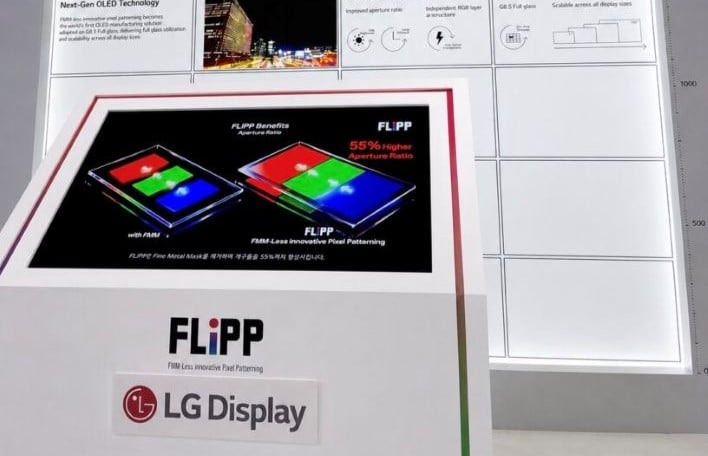
More so, this mask-less flexibility removes historical size limits, too. LG states that FLiPP can theoretically produce seamless displays ranging from tiny 1-inch virtual reality and wearable screens up to 100-inch television panels without requiring unique physical mask tooling.
So far, LG Display has secured global trademark filings for the technology and
officially presented its working prototypes at the International Meeting
on Information Display (IMID) in Busan. The company hopes to commercialize FLiPP commercially starting with medium-sized IT displays, including tablets and desktop monitors, before expanding into wearables and ultra-large premium televisions.





