



Japan Captures Stunning Two-Headed Asteroid In Daring Historic Flyby


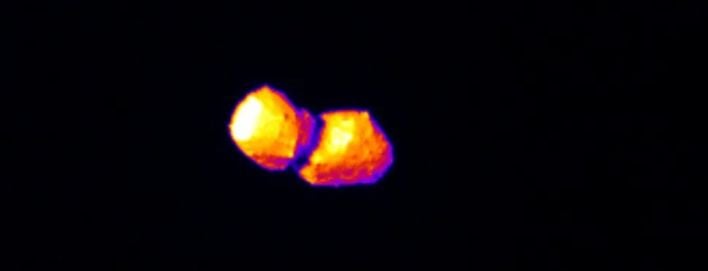
JAXA (the Japan Aerospace Exploration Agency) confirmed that on July 5 the probe skimmed just 800 meters from the center of the 450-meter-wide space rock. Traveling at a relative speed of 5 kilometers per second (roughly 11,000 mph) the spacecraft had only a fleeting window to lock its instruments onto the target. This achievement is impressive because Hayabusa2 was originally engineered for the slower orbital operations, not lightning-fast flybys. Mission controllers had to pre-program precise tracking sequences for the onboard Optical Navigation Camera–Telescopic (ONC-T) to ensure the asteroid wouldn't blur out of frame during the encounter.
This encounter also marks a positive opening chapter of Hayabusa2’s extended mission. After making history in 2020 by dropping off a capsule of pristine material from the asteroid Ryugu over the Australian outback, the probe still held a reserve of xenon propellant. So JAXA chose to utilize the remaining fuel for an extended deep-space cruise rather than decommissioning the spacecraft.
With Torifune already shrinking in its rearview mirror, Hayabusa2 is preparing for its next maneuvers. The spacecraft will loop back toward home for two consecutive gravity-assist flybys of Earth in December 2027 and June 2028, stealing planetary momentum to slingshot towards its ultimate destination: 1998 KY26, a minuscule near-Earth object measuring just 11 meters across. When Hayabusa2 reaches this rapidly spinning rock in July 2031, it will attempt an orbital rendezvous and surface touchdown, exploring an entirely different class of asteroid and continuing one of the most remarkably resilient voyages in the history of robotic space exploration.
Main image: Asteroid Torifune as seen by the Hayabusa2's Optical navigation camera (telephoto) (ONC-T) (Credit: JAXA)





