



Intel Wants To Embed MicroLEDs In CPUs For Lights And Diagnostics


Well, the micro-LEDs are actually the point. The patent describes a semiconductor package containing one or more micro-LED elements embedded in a glass substrate, with "through-glass vias" (TGVs) physically carrying power through the glass to the LED die. The glass itself can serve as the optical window through which the LEDs shine. Intel says this could be used for in-situ diagnostic indicators or for aesthetic components, including "light-up wording across a CPU." Intel also gives the example, as a specific embodiment in the patent, of a package formed from a glass substrate that includes micro-mirrors in the package itself so that light from the embedded LEDs can be redirected through the glass substrate.
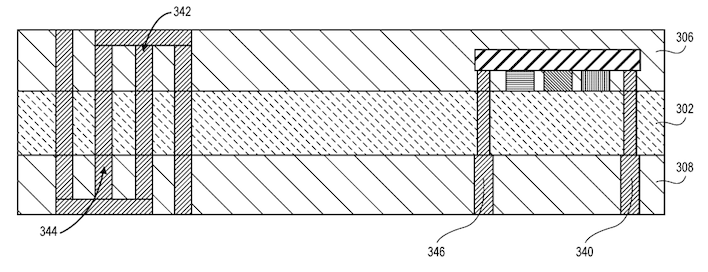
It's really the glass substrate that is the interesting part here. Glass semiconductor substrates aren't a completely new concept, but they haven't yet become a mainstream commerical packaging technology. There are pilot lines, prototype parts, and customer-qualification efforts underway, but volume deployment is still in the future. Glass is attractive because it has excellent dimensional stability and flatness compared with organic laminates. As packages get physically enormous and chipmakers cram tens of thousands of connections onto them, organic substrates start to suffer from warpage as well as challenges around thermal expansion and dimensional creep.
Intel has previously noted that its glass-core substrates could enable up to 10× higher interconnect density, larger package sizes, better signal integrity, higher-temperature processing, and potentially even optical interconnects integrated into the processor package. In light of that, the idea of sticking RGB LEDs on a CPU becomes considerably less silly, although Intel's examples aren't really helping the matter. It's easy to imagine a processor package with status lights directly on the package; a light-up Intel logo that will be buried under a heatsink is not particularly interesting.
What would be radically more interesting would be embedded micro-LEDs for optical signaling. Optical interconnects are a major topic of discussion in the industry right now because they have the potential to significantly reduce power usage (and thus heat output) as well as improving signal quality, since optical signals are immune to electrical crosstalk. Intel itself is actively researching co-packaged optics alongside glass-core substrates.

However, the patent doesn't actually discuss optical interconnects. In fact, it doesn't even contemplate photodiodes, optical waveguides, optical coupling, modulation schemes, high-speed SerDes, or an optical communication protocol. The patent is strictly concerned with integrating micro-LEDs into the package, not using them for anything other than projecting light.
Yet, while this patent doesn't describe an optical data path, the architecture it patents is very possibly a step toward eventually building them. What Intel has actually patented here is simply a particular way of integrating an LED semiconductor die into a glass package. Once that physical integration exists, someone (including Intel) could potentially build a different invention on top of it involving photodetectors, waveguides, modulation, and so on.
So no, I don't expect Intel will release any processors with light-up Intel logos. A processor package that can actually shine light through its own glass substrate is a wild thing to find in an Intel patent, though.





