



Intel Touts Breakthrough With World's Thinnest GaN Chiplet For AI Chips


Intel has unveiled a Gallium Nitride (GaN) chiplet measuring a mere 19 micrometers in thickness. First showcased at the IEEE International Electron Devices Meeting in December last year, this advancement marks the first time GaN-on-Silicon power components have been integrated into such a microscopic profile.
Modern computing faces a structural paradox: as processors become more powerful, the systems required to feed them electricity and manage heat become prohibitively large while current silicon-based power delivery is reaching its efficiency ceiling. GaN has long been the successor-in-waiting due to its ability to handle higher voltages and switch at faster speeds than pure silicon, but integrating it directly into a processor package has remained a manufacturing roadblock. Until now, that is. Intel’s breakthrough combines GaN and CMOS silicon on a single, ultra-thin chiplet, creating a hybrid system that maximizes the strengths of both materials.
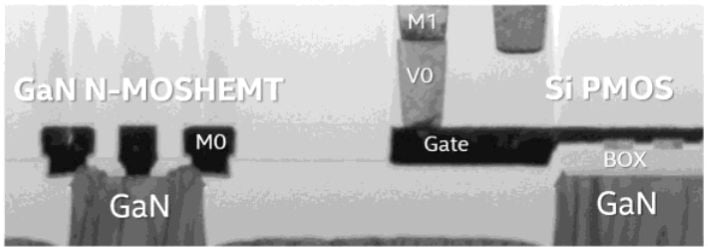
The 19-micrometer thickness/thinness is not just a miniaturization feat; it's actually a necessity for the next generation in 3D packaging. In advanced chip design, engineers are increasingly stacking components vertically to reduce the distance electricity must travel. By making the GaN power chiplet ultra-thin, it can be sandwiched between other layers of a processor without significantly increasing the overall height of the hardware. This proximity allows for point-of-load power delivery, where voltage is regulated millimeters away from the logic cores, drastically reducing the energy lost as heat during transmission.
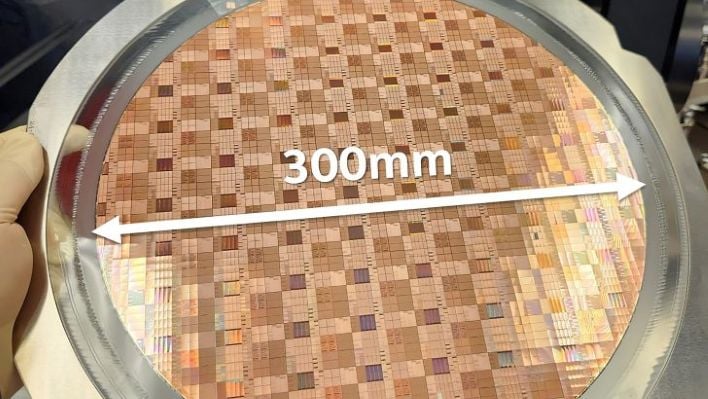
AI data centers stand to greatly benefit from the chiplet. As we know, they consume vast amounts of electricity, with a significant portion of that energy never reaching the actual transistors due to inefficient power conversion. Thus, Intel’s thin GaN solution can potentially reclaim that lost energy. Because GaN can operate at much higher frequencies, passive components like inductors and capacitors can also be shrunk. This translates to the entire PSU becoming smaller, cooler, and more responsive to rapid power fluctuations.
It's safe to say that new developments like the GaN chiplet reinforces Intel's position as a systems foundry. Since its launch in 2024, the company is focusing on how disparate technologies like GaN, optical interconnects, and advanced cooling interact within a single package. While others have indeed explored GaN for consumer chargers and telecommunications, Intel’s focus on enterprise AI data centers with GaN tech could prove to be a very fruitful one.





