



Intel Aims To Hire A Unified Core Engineer, What Does This Mean For Hybrid Designs?


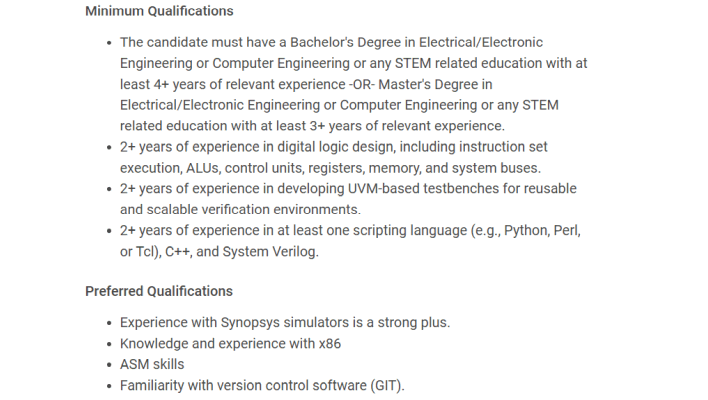
You can think of a CPU verification engineer as the hardware equivalent of a medical diagnostician. The job is all about differential diagnosis on chip designs, poking at billions of corner cases to make sure the CPU doesn't glitch out in weird scenarios. Their mission is quality assurance, not on the final chips, but instead on the raw design itself, using tools like UVM testbenches, system simulations, and a heap of scripting in Python or SystemVerilog to hunt down bugs before the chip even hits silicon. These are the folks that keep errata sheets from turning into dictionary-length tomes.

It's a weirdly niche skill set, requiring esoteric knowledge that very few people actually possess. The high top end of that salary band shows that Intel's serious about nabbing someone experienced. Modern CPUs are nightmarishly complex, with speculative execution, out-of-order pipelines, power gating, multiple clock domains, security features, and all kinds of other mess stacked on top. Verifying all that pre-silicon is no joke, and scaling up a team for it usually means something big's brewing.
That brings us to the juicy bit: "Unified Core team." Intel has not publicly announced the existence of any such team. Now, Intel's internal team names don't always scream product branding, of course. This could just be a label for streamlining design methodology or verification setup. However, rumors have been swirling that point to a bigger shift: architectural alignment across Intel's disparate core types, a bit like how AMD tweaks its Zen cores into dense "c" variants for efficiency without a full split.
Leaks tie this to Intel's roadmap post-2027, where Griffin Cove (purportedly slated for Razer Lake CPUs) might be the swan song for dedicated P-cores, paving the way for a unified design in stuff like Titan Lake or Hammer Lake around 2028-2029. This would ditch the P/E-core hybrid that's defined Intel since Alder Lake, aiming for better power efficiency, simpler software optimization, and a shot at matching AMD's uniform-ish approach. Picture it less as "one core to rule them all" and more like a single architectural DNA spawning multiple phenotypes. You'd still have "slow" cores and "fast" cores, it's just that they share an architecture.
If this "Unified Core" is indeed ramping up verification now, it suggests a new or heavily reworked microarchitecture is in the pipeline; teams don't bulk up like this for minor tweaks. The real question is what exactly "unified core" means. Absent any confirmation from Intel, we're loathe to make predictions, but we doubt Lip-bu Tan's Intel would spend a quarter-million dollars on a single bug hunter unless it's worried about the complexity of a new design.
Shout out to Gray for the spot!





