



Intel Core G3 Extreme Panther Lake Chip May Bring 12 Xe3 GPU Cores To Gaming Handhelds


At its CES 2026 presentation, Intel announced both its Core Ultra Series 3 processors (codenamed "Panther Lake") as well as a forthcoming reference platform for gaming handhelds based on the chips. Looking at the available configurations of the Core Ultra Series 3, it certainly seems like these parts are nearly tailor-made for the handheld PC gaming device market. Well, if the latest rumor is correct, there may be handheld-specific SKUs on the way.
Much in the same way that AMD repackaged its "Phoenix" laptop silicon as "Ryzen Z1 Extreme" and "Strix Point" as "Ryzen Z2 Extreme," Intel is purportedly planning to launch chips called Core G3 and Core G3 Extreme based on "Panther Lake." These SoCs will reportedly be slightly detuned from the top end Core Ultra Series 3 models, likely for power efficiency; as tuners will well know, backing of just a little on clocks and voltage can have an outsized effect on power savings.

According to the leaker, both Core G3 and G3 Extreme will have 14 CPU cores, configured as 2 P-cores, 8 E-cores, and 4 LP-cores. Peak CPU clock rates will be around 400MHz slower than the top-end Core Ultra X9 388H, but the GPU will be the full 12 Xe3-cores on the G3 Extreme, while the G3 will have ten Xe3-cores, both of which are clocked a bit below the Core Ultra X9 388H—again, likely for improved power efficiency. These integrated GPUs will supposedly be called "Arc B380" and "Arc B360," to separate them from the "B390" and "B370" nomenclature used on the standard Core Ultra Series 3 chips.
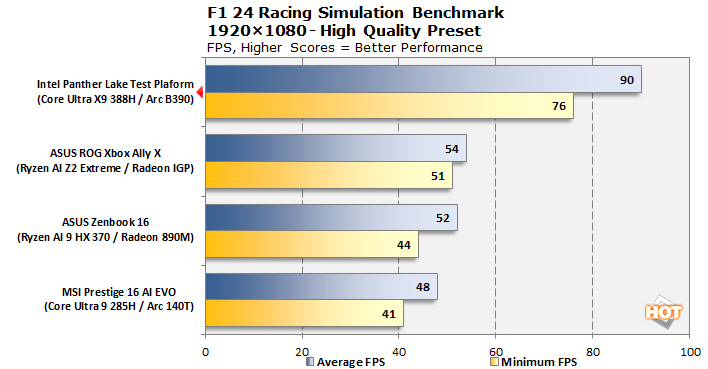
Given the performance lead that Intel has claimed (and demonstrated, in our early testing) over AMD's Strix Point parts—with a supposed average gain of 82% versus the Ryzen AI 9 HX 370 in 1080p gaming—it's completely feasible that it could achieve real 1080p, 60 FPS gaming performance on a gaming handheld without having to make severe compromises using upscaling. Alternatively, it's possible that Intel's new parts could make use of low-loss XeSS upscaling and run at a preposterously low power level of 10W or below. It all depends on just how efficient the new parts actually are.
This news comes by way of Videocardz, which reports that its sources didn't know anything about release timing. We'd be surprised if it's much later than Q2 of this year, assuming reports are correct. That still gives Intel plenty of time to get some devices out with its partners, which apparently includes not only extant handheld partners MSI and GPD, but also Acer, Compal, OneXPlayer, Pegatron, Quanta, Wistron, and even Microsoft. We're extremely keen for more competition in this horribly homogenized hardware segment, so this is very exciting.





