



Dying Comet Stuns Astronomers As Hubble Records A Wild Spin Flip


Hubble has captured a phenomenon never before witnessed in the world of astronomy: a comet that slowed and then began spinning in the opposite direction. No alien intervention was involved in this one (as far as we know).

Initially, the comet’s rotation period was measured at about 20 hours. However, by the time NASA’s Swift satellite and the Hubble Space Telescope caught up with it, the spin had slowed significantly, stretching to nearly 60 hours. When Hubble looked again in late 2017, the rotation had accelerated back up to 14 hours. The only possible explanation for this time differential is that the jets pushed against the comet’s original spin until it ground to a halt and then forced it to rotate the other way.
David Jewitt, a researcher at UCLA, compared the process to pushing a merry-go-round. If you push against the direction of movement, you can eventually stop it and send it spinning the other way. In the case of 41P, the pushes came from the uneven distribution of these gas vents.
That said, the 41P occurrence could give us a peek into the reality of small comets. Rather than simply fading away as their ice evaporates, many appear to spin themselves to death. If these jets continue to increase the rotation speed, the centrifugal force will eventually overcome the comet’s weak internal gravity. This can lead to a cascading fragmentation in which the comet sheds massive chunks of itself or disintegrates entirely.
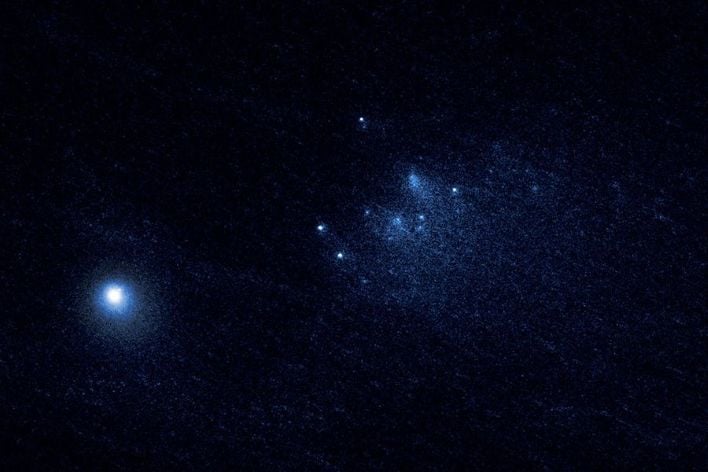
For 41P, astronomers estimate that if these outbursts continue once every orbit, the comet could be gone in as little as 25 years.





