



GeForce RTX 5070 Ti Memory Gets Overclocked To A Scorching 39 Gbps


If you're wondering how adding 5500 MHz is even possible, and also wondering how it added 11 Gbps to the transfer rate, let me explain. GDDR7 transfers sixteen bits per clock thanks to its design. That "+5500 MHz" number is actually even more confusing, because it's an intermediate data rate number. The actual clock rate at 39 Gbps is 2437.5 MHz, and the pre-DDR data rate is 19500 MT/s. That's an increase of 5500 MT/s over the stock 14,000 MT/s, which turns into 28 Gbps when you account for DDR signaling. Here, this chart might help:
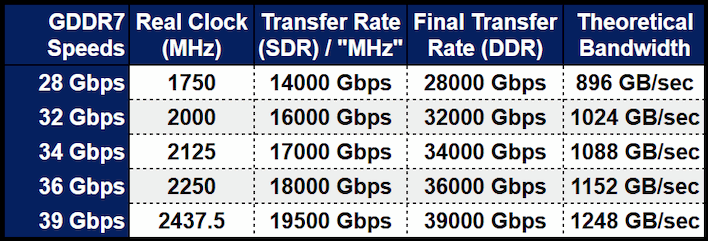
As you can see, the bandwidth increase is easier to understand. The GeForce RTX 5070 Ti has a 256-bit memory bus, so its stock 28-Gbps memory provides 896 GB/s of theoretical bandwidth. At 39 Gbps, that rises to 1,248 GB/s—a 39.3% increase, essentially matching the increase in memory data rate. That pushes the memory bandwidth well ahead of the GeForce RTX 5080, and in fact within striking distance of the GeForce RTX 5090 D V2, the slightly-neutered RTX 5090 that was built for the Chinese market before Beijing banned the boards from entering the country.
Actually getting a GeForce RTX 5070 Ti to run its RAM at 39 Gbps is quite a feat, as you'd expect. The Redditor says +5500 worked in Cyberpunk 2077 with path tracing enabled for 30 minutes, while +6000 immediately caused the graphics driver to restart. Other users have reported lower ceilings, with examples around +4500 and +5000, and at least one user reporting artifacts beyond +5500. That makes it clear that results will vary from card to card and, potentially, depending on the memory chips installed on the board.

The performance gains are also nowhere near as dramatic as the memory bandwidth increase. The original tester, /u/Sad-Victory-8319, reported roughly 1 FPS of additional performance in Cyberpunk 2077 for every +1000 MHz of memory offset, while another user reported a roughly 1.5% to 2% increase in 3DMark Speed Way when moving from +3000 to +5000. In the former test, +5500 represented roughly a 5- to 6-FPS improvement over stock memory settings. A bit unimpressive, but not unexpected; GDDR7 is so fast even at stock settings that these GPUs are almost never bandwidth-bound.
Interestingly, despite that they use the same Samsung GDDR7 memory, similar experimentation on GeForce RTX 5090 cards appears to hit a lower ceiling. Users in the Overclock.net "RTX 5090 Owners Club" thread have also been toying with the mVolt+ tool, and they report getting to roughly +4000 MHz before driver resets become an issue. Why the 5070 Ti appears capable of going substantially further isn't yet clear, but it could have to do with the half-width memory bus or the considerably higher strain on the RTX 5090's power delivery hardware.

Either way, the discovery here is notable because it suggests at least some, and possibly a majority of RTX 50-series cards have a considerable amount of untapped GDDR7 frequency headroom. Whether running a gaming GPU at these kinds of memory speeds is sensible for long-term use is a separate question, particularly considering the fairly minimal performance gains to be found from even extreme overclocks like this. Still, it's hard not to be a little impressed by the sight of "39 Gbps" memory on a GeForce RTX 5070 Ti.





