



Geekbench Warns Intel's New Optimization Tool Can Skew CPU Benchmark Results


So what's the big deal? Well, as you've probably guessed, the one app is Geekbench. Enabling iBOT for Geekbench raises scores considerably, with certain workloads improving as much as 40% and overall scores increasing by as much as 8% over the same system without iBOT enabled. Primate Labs, developers of Geekbench, have decided that it's not fair to compare standardized results against iBOT results, so it has started marking results run with the feature enabled in its database so users know what they're looking at.

Slide: Intel
Now, to Intel's credit, it was very up-front about this detail and almost apologetic in tone in its reviewers' guide. The iBOT is disabled by default, and users have to manually enable it, with the Geekbench optimizations requiring a specific 'Advanced' view to be enabled first. So saying, it's not like Intel is trying to cheat the benchmark. Moreover, as Intel points out, while iBOT modifies code in memory, it does not alter the final output of the code; deterministic code remains deterministic and so the work being done is the same. It's just faster.
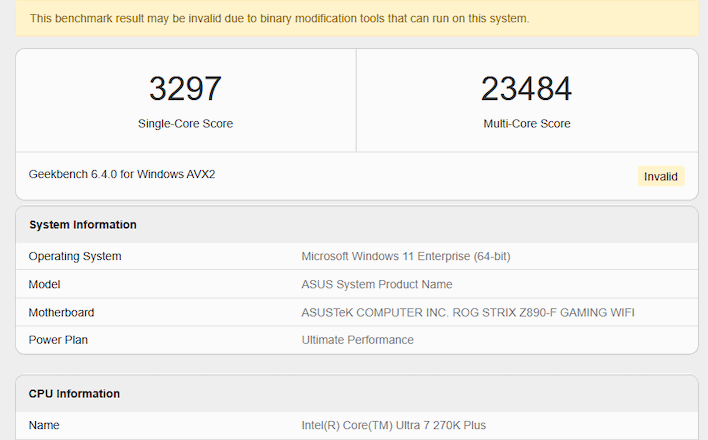
With that in mind, while we completely understand Primate Labs' decision to mark iBOT results with a warning that says "This benchmark result may be invalid due to binary modification tools that can run on this system," we also think it's a little unfair. If you have a compatible CPU, you should have iBOT installed, and you should probably have it enabled for all the apps it supports. There's really no reason not to. So in a sense, iBOT performance is indeed the real performance of those processors.

Of course, there's also the point of view that iBOT only supports a very scant few applications, and so you could argue that iBOT performance isn't representative of the performance you'll get in most applications on the machine. That's a totally fair argument, too, so we definitely see both sides of the discussion.
Ultimately how necessary the Primate Labs warning actually is will really depend on how well Intel does at maintaining and updating the iBOT tool. Intel's earlier and rather similar in concept (albeit different in implementation) Applications Performance Optimization tool has seen relatively few updates since it was first released with the the previous Intel CPU refresh, the 14th-Generation Core Processors.
If iBOT is different and it is continually updated with new optimizations for new apps, then it might be arguable that iBOT performance represents the "true" capability of the chip. If this is going to be as good as it gets, well, iBOT is basically a gimmick even if the performance gains it offers are real. We actually think iBOT is a really cool technology and we'd like to see it proliferate; it offers a similar benefit to compiling the software from source yourself, at least in concept. Hopefully Intel supports it with more profiles in the near future.





