



Engineer Turns An E-Ink Dev Board Into A Slick 60Hz Game Boy Handheld


The result runs monochromatic Game Boy games at up to 60 Hz on an e-ink display, and the result is truly remarkable to see in action. Games including Pokemon Blue, Super Mario Land, and The Legend of Zelda: Link's Awakening all run well on the so-called "PaperBoy S3," though it's not completely perfect.
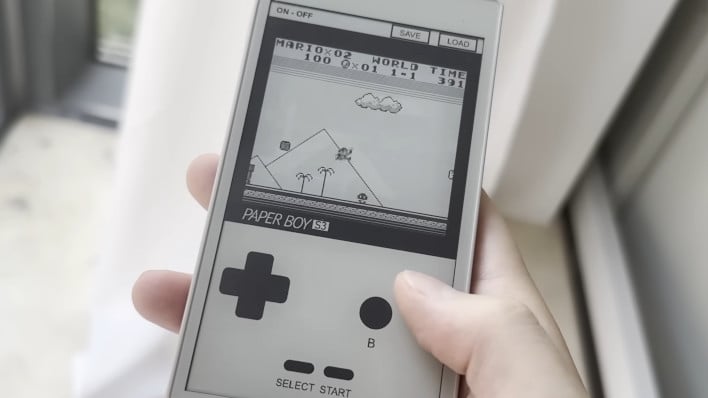
One of the biggest key downsides is audio reproduction. On the PaperBoy S3, the original audio can't be reproduced at full clarity. This results in audio instead being represented with shrill beeps, but the approximation is close enough that the original music is still recognizable, if inadvertently remixed by the hardware.
Additionally, frame-skipping is employed by the underlying CrankBoy emulator to account for semi-frequent dips below 60 FPS. While it may strain credibility to believe that the Game Boy of all things is too intense for a semi-modern chip like the ESP32, it is important to remember that emulation by nature introduces overhead and that the ESP32 was never particularly powerful. For audio to work at all, one of its two cores is fully-dedicated to it here.
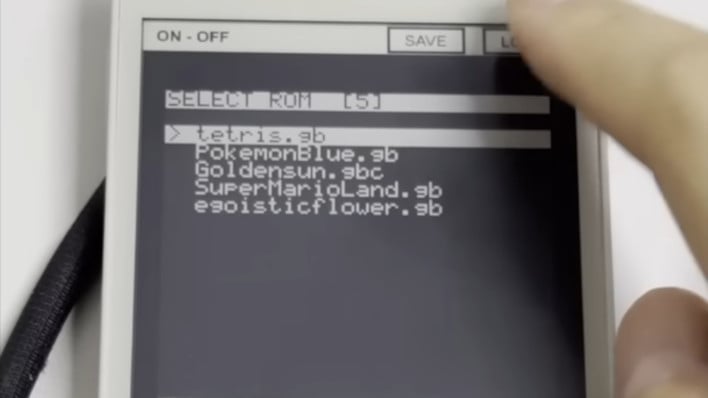
It's hardly perfect, but the result is still remarkable and most importantly, pretty cool. Zhang also customized the emulator to support Save/Load state features, allowing for suspend and resume functionality with just a few extra taps. As a long-time emulation enthusiast, though, I do advise caution: savestates that predate in-game saves cause save corruption if loaded after the fact, so be sure to keep your savestate up-to-date with your manual saves.
The final result is remarkably fluid and sharp, especially for an e-ink display typically associated with heavy ghosting for scenarios like this. The supported Game Boy games run well and look great, and the touchscreen buttons are rendered so sharp that they could be mistaken for real ones at a straight viewing angle. There's even limited Bluetooth LE controller support, though Zhang admits that compatibility is inconsistent.
In any case, it's nice to see efforts from developers and vendors alike to keep e-ink alive. Smartwatch pioneer Pebble still makes watches with e-ink displays, and there are still some impressive modern e-ink displays in development, albeit highly expensive ones. While e-ink doesn't lend itself to gaming outside of niche scenarios like this, it's still a great technology for reducing eyestrain and power consumption versus modern display types.




