



ASUS Unveils Ryzen AI-Powered P700 Mini Tower With RTX 50 Firepower


ASUS is expanding its sleek and stylish (in a business casual way) ExpertCenter desktop lineup with the launch of the ExpertCenter P700 Mini Tower (PM700MG) powered by AMD's latest-generation Ryzen AI 400 series Gorgon Point processors revealed at CES. According to ASUS, the refreshed design extends past the core hardware, resulting in a "whisper-quiet" system.
While admittedly not super exciting like some high-powered gaming desktops we've seen, ASUS managed to cram some neat bits into its retooled 15-liter chassis. Processor options include the Ryzen AI 7 445 (2x Zen 5 cores at up to 4.6GHz, 4x Zen 5c cores at up to 3.4GHz, 8MB L3 cache, 6MB L2 cache) or Ryzen AI 5 430 (1x Zen 5 core at up to 4.5GHz, 3x Zen 5c cores at up to 3.4GHz, 8MB L3 cache, 4MB L2 cache).
Both of those come with integrated graphics (Radeon 860M on the 440 and Radeon 840M on the 430), though ASUS is offering several discrete GPUs: NVIDIA RTX A400 (4GB GDDR6), GeForce RTX 3050 Dual (6GB GDDR6), GeForce RTX 5050 Dual (8GB GDDR6), and GeForce RTX 5060 Dual (8GB GDDR6).
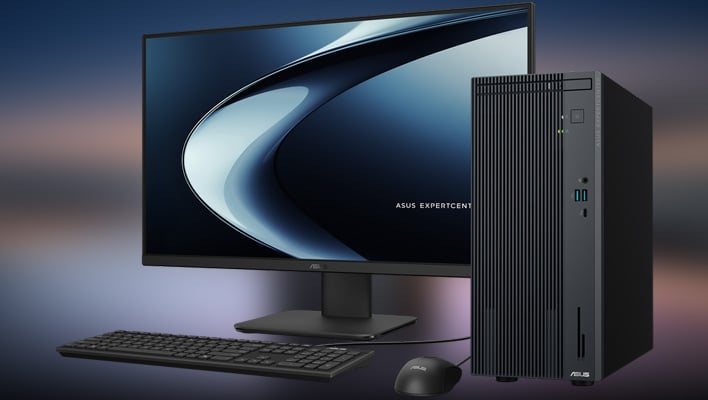
Buyers can also configure the P700 with up to 64GB of dual-channel DDR5-5600 memory and up to a 1TB SSD + 2TB HDD. It has two SO-DIMM slots, two SATA 6Gbps ports, a single 3.5-inch drive bay, and a single M.2 slot.
According to ASUS, this combination yields up to 2.5x faster AI computing performance for things like generative AI, video editing, and large language model (LLM) inference. The company is also claiming up to a 31% improvement in overall performance compared to other systems in a similar price range.
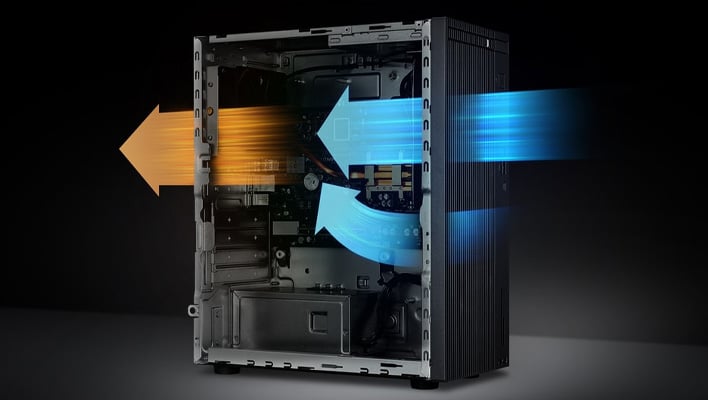
ASUS also touts an upgraded cooling system.
"ExpertCenter P700 Mini Tower introduces an innovative thermal design that sets it apart from traditional tower PCs. An efficient copper heat pipe rapidly transfers heat away from critical components, while a rear-positioned high-efficiency fan establishes an optimized airflow path — drawing in cool air from the front and expelling warm air through the back. This combination ensures that the system maintains consistent, reliable performance, even under heavy workloads," ASUS says.
Despite the chest-thumping over the bang-for-buck proposition, there's no mention of the ExpertCenter P700's actual price in the press release. However, a quick peek on Amazon shows previous generation models starting at around $750.




