



AMD Surges To 36% Desktop CPU Share To Chip Away At Intel's Dominance


AMD continues to make strides in chipping away at Intel's dominant market share lead in the x86 CPU space. According to the latest data from Mercury Research, total x86 processor shipments for the fourth quarter actually declined, which the market research firm highlighted as unusual, given that the highest sequential total unit growth of the year typically occurs in the final quarter of the year. Even so, AMD saw some impressive gains in multiple segments.
Starting with desktop CPUs (excluding IoT), AMD increased its share to 36.4% compared to 33.6% in the previous quarter. Even more impressive is that AMD's desktop CPU share is up nearly 10% from a year ago, when it was holding steady at 26.9%.
Meanwhile, Intel still has a big lead, though it continues to give up ground to its rival. In the same quarter a year ago, Intel's desktop CPU share sat at 73.1%. That fell to 66.4% by the third quarter, and slipped to 63.6% in the fourth quarter.
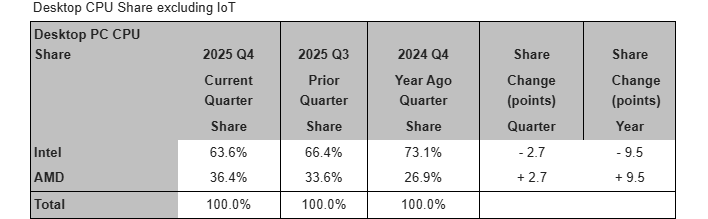
Source: Mercury Research
Suffice to say, AMD's desktop share is at a record high. Also interesting is that unlike previous quarters where AMD's Granite Ridge (Ryzen 9000 series based on Zen 5) processors were the primary growth driver, Mercury Research says AMD's shipments were broadly higher across the board, including older CPUs and Phoenix Point APUs (Ryzen 7040 series based on Zen 4).
Part of the reason why AMD was able to gain so much ground against Intel on the desktop was because Intel "intentionally reallocated manufacturing to server CPUs earlier in the year." The market research firm says this had a negative impact on Intel's ability to build and sell PC processors. Intel's supply constraints also played a role.
Source: Mercury Research
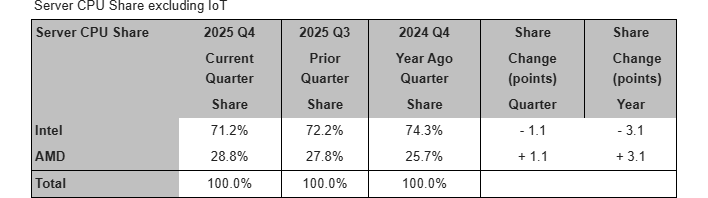
Even with that being the case, AMD made strides in server share as well, albeit not as big as on the desktop. AMD ended the fourth quarter with a 28.8% share of the server CPU market (excluding IoT), up from 27.8% in the previous quarter and 25.7% last year.
While these are smaller gains compared to the desktop, AMD is quick to point out that its server CPU revenue share is at an all-time high at 41.3%. It's also the first time that AMD's server revenue share breached the 40% mark (it was at 39.5% in the third quarter and 36.4% a year ago).
That said, Intel's second-biggest lead is in the server sector. It's server CPU share sits at 71.2%, down from 72.2% in the third quarter and 74.3% a year ago.
"Server CPU shipments were up strongly with Intel's shipments growing at
nearly double the seasonal average, and AMD grew at more than triple the
average, with both suppliers indicating the outlook into 2026 will be
even stronger," said Dean McCarron, President of Mercury Research.
Intel's biggest lead is in mobile where it owns 74% of the market. That's down from 78.1% in the third quarter and from 76.2% a year ago, but well ahead of AMD, which increased its share to 26% (up from 21.9% in the third quarter and from 23.8% a year ago).
As for ALL CPU segments, including IoT and SoCs, the split between Intel and AMD is at 68.7% and 31.3%, respectively, versus 69.1% and 30.9% in the third quarter and 74.4% and 25.6% last year.




