



AMD Data Center Server Market Share Hits New High, Desktop Chips Away At Intel Too


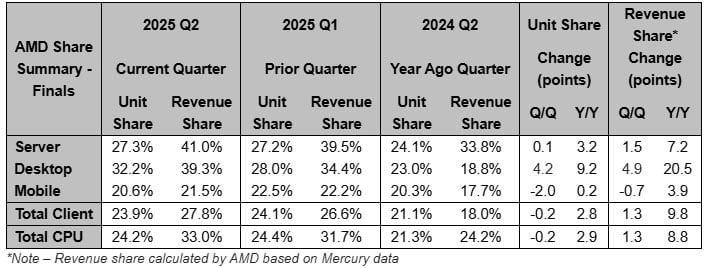
The once heavily lopsided rivalry between AMD and Intel in pursuit of market share and the revenue that comes with it has become a much more tightly contested battle. Case in point, AMD sent us a email highlighting some interesting figures from Mercury Research's second quarter report, which notably includes AMD achieving a record 41% server revenue share.
AMD's EPYC growth slowed a bit compared to previous gains, as its revenue share in the same category was 39.5% in the previous quarter. However, the year-over-year ascension is impressive—AMD's server revenue share in the second quarter of 2024 was at 33.8%, so that amounts to a nearly 6% gain in the past 12 months.
The unit share breakdown paints a more muted picture—AMD's server chips captured 27.3% of the market in the second quarter of 2025, which is virtually unchanged from 27.2% in the previous quarter and up a few percentage points from 24.1% in the second quarter of 2024.
Intel is still selling more server chips than AMD and it's not really close, though AMD can certainly be pleased that it continues to chip away at its rivals big lead. Meanwhile, the revenue split is much closer these days. That's especially important in the lucrative data center sector where there are typically much higher margins to be had compared to consumer chips.
Source: Mercury Research (via AMD)
Speaking of which, AMD is gaining ground on the consumer side too, with the company trumpeting "ongoing client gains driven by Ryzen desktop demand." That's even underselling the situation. AMD's revenue share on the desktop has exploded from 18.8% in the second quarter of 2024 to 39.3% in the second quarter of 2025 (and up from 34.4% in the previous quarter).
It's also seeing chunkier gains in unit share for its desktop chips—it now sits at 32.2%, up from 28% in the previous quarter and 23% year-over-year.
That's not to hard to fathom, given that AMD is pretty much firing on all cylinders these days while Intel is in the midst of a restructuring effort that has entailed mass layoffs and a newly appointed CEO in Lip-Bu Tan. Intel is still in good shape with some interesting technologies in the pipeline, but AMD is enjoying its time in the limelight.
Whereas AMD used to largely be considered a budget-oriented alternative to Intel, these days it's churning out high-end products that are more competitive than, say, the days of Bulldozer. For example, AMD is wooing gamers with its X3D chips that stack 3D V-Cache for a performance boost in games. It's also put itself in the good graces of gamers with socket longevity, something that Intel may strive to emulate starting with Nova Lake. Intel is also rumored to be working on it's own version of 3D V-Cache called bLLC, or Big Last Level Cache.
So it remains to be seen if Intel can make this a more lopsided landscape in the future. For now, however, AMD continues to close the gap. Ryzen chips dominate the top-selling CPUs on Amazon, and as the latest Mercury Research data shows, it's claiming a big share of revenue on the server side too. As for mobile, well, the data in the chart above shows there is clearly more ground to be made up.




