



AMD Report Says Zen 6 EPYC Venice Smokes NVIDIA Vera In Revised Agentic AI Benchmarks


The updated analysis places particular priority on agentic AI infrastructure, where CPUs handle tasks such as orchestration, databases, web services, caching, APIs, retrieval, and other work surrounding accelerator-based AI inference. This work is now comprising a larger and larger percentage of the actual workload of Agentic AI, reinforcing the role of CPUs in the datacenter, once thought to merely be orchestration for GPUs that do all the 'real' work.

AMD expects that the EPYC 9996 will deliver 2.4× the performance of Xeon 6980P in server-side Java, 2.5× in OpenSSL, 3.5× in MongoDB with YCSB, 2.9× in Redis Benchmark, 3.7× in NGINX with WRK, and 2.6× in transaction processing based on TPC-C. Those results are normalized to a 128-core Xeon 6980P system and represent the CPU-heavy enterprise and cloud-native portions of an agentic AI infrastructure stack. Notably, Vera was not included in this modeling, but not because AMD didn't have numbers to compare against.

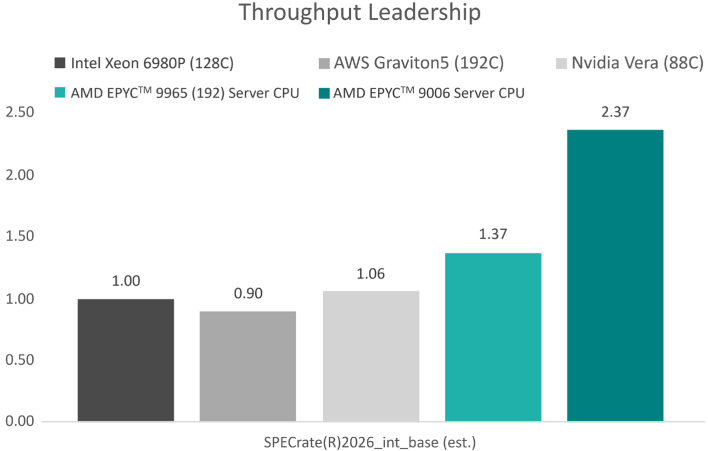
Besides, the more eye-catching update comes at the rack level. AMD has revisited its earlier 100-kW rack-capacity model from June, which estimated how much aggregate workload throughput each platform could deliver within a fixed rack-level power envelope. The company says the previous analysis put 5th Gen EPYC 9965 at 2.37× the rack-level throughput of its NVIDIA Vera baseline. The revised study now models the 6th Gen EPYC 9996 at 3.4× Vera's rack-level performance.
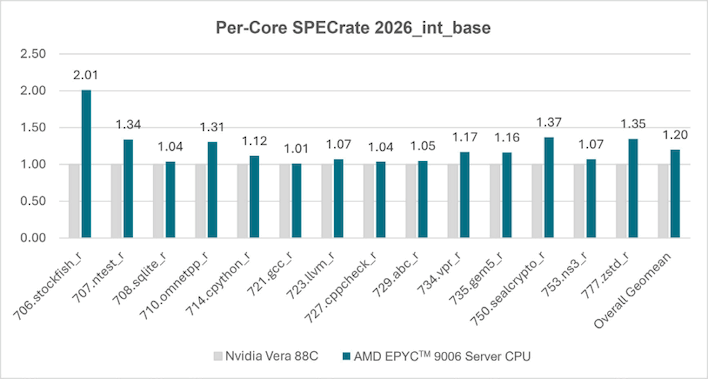
This is partially because the underlying methodology has changed. AMD's earlier rack estimate was based on a six-workload geometric mean that included SPECrate 2017 Int, while the updated model incorporates SPECrate 2026 Int, server-side Java, NGINX, Redis, Memcached, and TPROC-C. That makes the latest figure a refreshed model rather than simply adding Venice to the old chart. There's also a small but interesting change for AMD's previous-generation part. The earlier 9965 estimate was 2.37× Vera, while the new chart shows the 9965 at about 2.3× in the revised model. In other words, AMD appears to have rerun the calculations rather than simply carrying its previous numbers forward.
However, it's critical to keep in mind with these rack-scale comparisons that AMD is modeling performance rather than publishing results from physical 100-kW racks containing both Venice and Vera hardware. The company describes the figures as estimates based on a combination of benchmark data and system-level assumptions, so they absolutely should not be treated as apples-to-apples measurements of shipping systems.
But AMD's also making a broader argument about the role of CPUs in agentic AI. Rather than treating the CPU as merely a host for an accelerator, the company says increasingly complex AI workflows require substantial CPU resources for orchestration, retrieval, database access, tool execution, networking, and response generation. The latest EPYC 9996 figures reinforce AMD's pitch for Venice as a high-core-count CPU designed to maximize useful work under real-world rack constraints rather than simply chasing peak processor performance.

Still, Vera is a more specialized CPU than Venice, and it has a very different architecture at the platform level. While these simulations put NVIDIA's new chip behind AMD's finest, NVIDIA claims the win in its own testing using different benchmarks and constraints. It's entirely possible that Vera may end up being a better choice for some workloads. We'll just have to wait for independent benchmarks on real hardware to know for sure.





